Why Diceless Tabletop RPGs Work
Diceless tabletop RPGs have challenged conventional wisdom since the earliest days of the hobby. For many players, the idea seems almost contradictory. Dice have been part of tabletop roleplaying games for decades, deciding everything from combat and spellcasting to diplomacy and exploration. After so many years, it is easy to assume that they are also responsible for the excitement that keeps players coming back to the table.
That assumption explains one of the first questions people ask when they discover Legends of Thaloranth.
“Without dice, where does the tension come from?”
It is a fair question because uncertainty lies at the heart of every memorable roleplaying game. If success and failure are no longer determined by chance, many players naturally wonder whether every challenge becomes predictable. Without the possibility of an unexpected roll changing the course of events, it can seem as though victory becomes inevitable and failure becomes almost impossible.
The reality is very different.
The strongest diceless tabletop RPGs do not remove tension from the game. Instead, they shift its source. Rather than placing uncertainty in the hands of random chance, they place it in the decisions players make, the resources they commit, and the consequences those decisions create. Every meaningful choice carries weight because players understand that what they decide now will influence everything that follows.
Legends of Thaloranth was built around that philosophy from the beginning. It was never intended to imitate a traditional fantasy roleplaying game after removing the dice. Instead, it asks a different question: What happens when player decisions become the driving force behind success and failure?
The answer influences every part of the game, from combat and social encounters to character advancement and long-term campaign play. If you’ve already read What Is Legends of Thaloranth?, you’ve seen how the system emphasizes meaningful choices over random outcomes. Understanding why that philosophy works begins with recognizing an important distinction that is often overlooked in tabletop gaming.
Randomness Is Not the Same as Tension
Randomness Creates Uncertainty
One of the most common misconceptions surrounding diceless tabletop RPGs is the belief that randomness and dramatic tension are the same thing. They often appear together in traditional roleplaying games, making the assumption understandable, but they serve very different purposes.
Randomness creates uncertainty because no one knows exactly what the next die roll will produce. A hero may succeed against overwhelming odds because fortune intervenes at precisely the right moment. An experienced adventurer may fail at a routine task because probability happens to turn against them. Those moments can certainly be memorable, and they have become part of tabletop gaming’s shared culture for generations.
Surprise, however, is not the same as dramatic tension.
Tension Comes From Meaningful Stakes
Think about your favorite novel, film, or television series. The scenes that remain memorable years later are rarely the result of random chance. They matter because the characters faced meaningful decisions with important consequences. A leader commits an army knowing defeat could destroy an entire kingdom. A detective accuses the wrong suspect and risks allowing the real criminal to escape. A healer must decide which of two wounded companions can be saved first.
None of those moments require dice to become emotionally powerful because the tension already exists. The audience understands what is at stake, recognizes that every option carries consequences, and appreciates that there may not be a perfect solution.
Roleplaying games create tension in much the same way. Players become invested because their characters have something worth protecting, something worth achieving, and something they may lose if events unfold poorly. The mechanics determine how those situations are resolved, but the emotional investment exists long before anyone reaches for a die.
Understanding that distinction changes the way we think about diceless tabletop RPGs. Once tension is viewed as the product of meaningful decisions rather than random outcomes, it becomes much easier to understand how a game can remain exciting without relying on dice to create uncertainty.
What Dice Actually Do
Dice Create Surprise
None of this suggests that dice are somehow flawed or that traditional tabletop RPGs are doing something wrong. Dice have remained part of roleplaying games for decades because they provide experiences that many players genuinely enjoy. Random outcomes create surprises that no one at the table could have predicted, and those unexpected moments often become the stories people remember long after a campaign has ended.
Entire adventures have been shaped by an unlikely critical hit, a miraculous saving throw, or a spectacular failure at exactly the wrong moment. Those experiences are part of what makes many traditional roleplaying games so enjoyable, and they continue to be one of the defining characteristics of the hobby.
Dice Can Reduce Player Agency
At the same time, randomness can occasionally separate outcomes from player decisions. A carefully planned strategy may fail because a single roll produces an unexpected result. Likewise, a reckless plan may succeed because fortune happens to favor the players at exactly the right moment. Neither outcome is inherently good or bad, but both illustrate an important point: chance sometimes becomes the deciding factor instead of the players’ judgment.
Legends of Thaloranth takes a different approach. Rather than asking players to hope probability works in their favor, it asks them to evaluate the situation, consider their available resources, and decide how much they are willing to commit before taking action. Success and failure remain uncertain, but that uncertainty grows from the decisions players make rather than from the numbers appearing on a die.
That single shift lays the foundation for everything that follows.
Where Real Tension Comes From
Meaningful Decisions Create Dramatic Tension
If randomness is not the true source of dramatic tension, then what is?
The answer is surprisingly simple. Tension emerges whenever players must make meaningful decisions while facing meaningful consequences. Every roleplaying game, regardless of its mechanics, eventually asks its players to weigh risk against reward. Should the party press deeper into the dungeon with dwindling supplies? Is it worth trusting a stranger who offers valuable information but asks uncomfortable questions in return? Should the heroes fight now, negotiate instead, or retreat and live to face the challenge another day?
These moments create tension because the players understand that every choice matters. There is something valuable to gain, something equally valuable to lose, and no guarantee that the path they choose will prove to be the correct one. The uncertainty comes from the decision itself rather than from the mechanic used to resolve it.
This philosophy sits at the center of Legends of Thaloranth. Instead of asking players to wait for the dice to determine what happens next, the game encourages them to think carefully about the situation before acting. Every important decision becomes an opportunity to evaluate priorities, consider the resources available, and decide how much the objective is truly worth.
That shift changes the emotional experience of play in subtle but important ways. Rather than feeling like observers waiting for chance to reveal the outcome, players become active participants in creating it. Every success reflects a decision that proved worthwhile. Every setback offers an opportunity to look back, reconsider earlier choices, and approach the next challenge with a deeper understanding of the situation.
Stakes Give Every Choice Meaning
A difficult decision only creates tension when something meaningful is at stake. Choosing between two identical paths through a forest is rarely memorable because the outcome carries little consequence. Choosing whether to risk the party’s remaining resources to rescue an innocent prisoner before the enemy reinforcements arrive is something else entirely. The players recognize that whatever they decide will shape the story, and that realization transforms a simple choice into a dramatic moment.
Because Legends of Thaloranth places decisions at the center of play, the stakes remain visible throughout every scene. Players understand what they hope to accomplish, what they stand to lose, and what sacrificing additional resources may cost them later. They are not simply reacting to events as they unfold. They are actively deciding how much those events matter to their characters.
This is one of the reasons the game emphasizes scenes rather than isolated actions. As discussed in What a Scene Looks Like in Legends of Thaloranth, every scene represents a complete dramatic situation with its own objectives, obstacles, and consequences. The decisions made during those scenes influence everything that follows, creating a continuous chain of cause and effect that keeps players invested from beginning to end.
When viewed from that perspective, the absence of dice becomes much less significant. The uncertainty has not disappeared. It has simply moved from random chance to the far more personal question every player eventually faces:
“What am I willing to risk to achieve what matters most?”
Resource-Driven Play
Action Points Replace Random Chance
Every roleplaying game needs a way to answer an important question: What determines success when the outcome is uncertain? Traditional systems usually rely on dice to provide that answer. Legends of Thaloranth takes a different approach by placing that responsibility in the hands of the players themselves.
Instead of rolling to discover whether an action succeeds, players decide how much effort they are willing to invest before they act. That investment is represented through Action Points, commonly referred to as AP. More than a measure of physical stamina, Action Points represent a character’s focus, determination, awareness, and willingness to commit themselves to the challenges unfolding around them.
Every character begins a scene with a limited pool of Action Points. That pool is intentionally finite. Unlike an unlimited resource that can be spent without consequence, every Action Point committed to one action is unavailable for the next. Players quickly learn that every decision carries an opportunity cost, making resource management an essential part of every scene rather than an occasional consideration.
Because Action Points refresh at the end of a scene, the focus naturally shifts away from individual actions and toward the larger situation. Players are encouraged to think beyond the immediate obstacle, weighing the importance of what they hope to accomplish now against the possibility that greater challenges still lie ahead. The question is no longer, “Can I succeed?” Instead, it becomes, “How much am I willing to invest to succeed?”
Every Action Carries a Cost
This simple change transforms the emotional rhythm of play. A character may decide to commit significant resources to overwhelm an opponent quickly, knowing that doing so leaves fewer options if the fight continues longer than expected. Another player may choose a more conservative approach, preserving Action Points for future challenges while accepting a greater risk in the present. Neither decision is automatically right or wrong because every scene develops differently.
What makes these choices meaningful is that the consequences remain visible throughout the encounter. Players always know how many Action Points remain, allowing them to judge the risks they are taking as the situation evolves. Every decision influences the next one, creating a continuous series of trade-offs that reward thoughtful planning without slowing the pace of the game.
If you’ve already read What a Scene Looks Like in Legends of Thaloranth, you’ve seen how scenes provide the framework for this style of play. Action Points give those scenes their dramatic tension. Together, they encourage players to think about the encounter as a whole rather than treating every action as an isolated event.
Rather than leaving the outcome entirely to chance, Legends of Thaloranth asks players to manage a resource they can see, understand, and control. The uncertainty remains because no one knows exactly how the scene will develop or what challenges may still appear. The difference is that players face those uncertainties through meaningful decisions instead of relying on fortunate dice rolls.
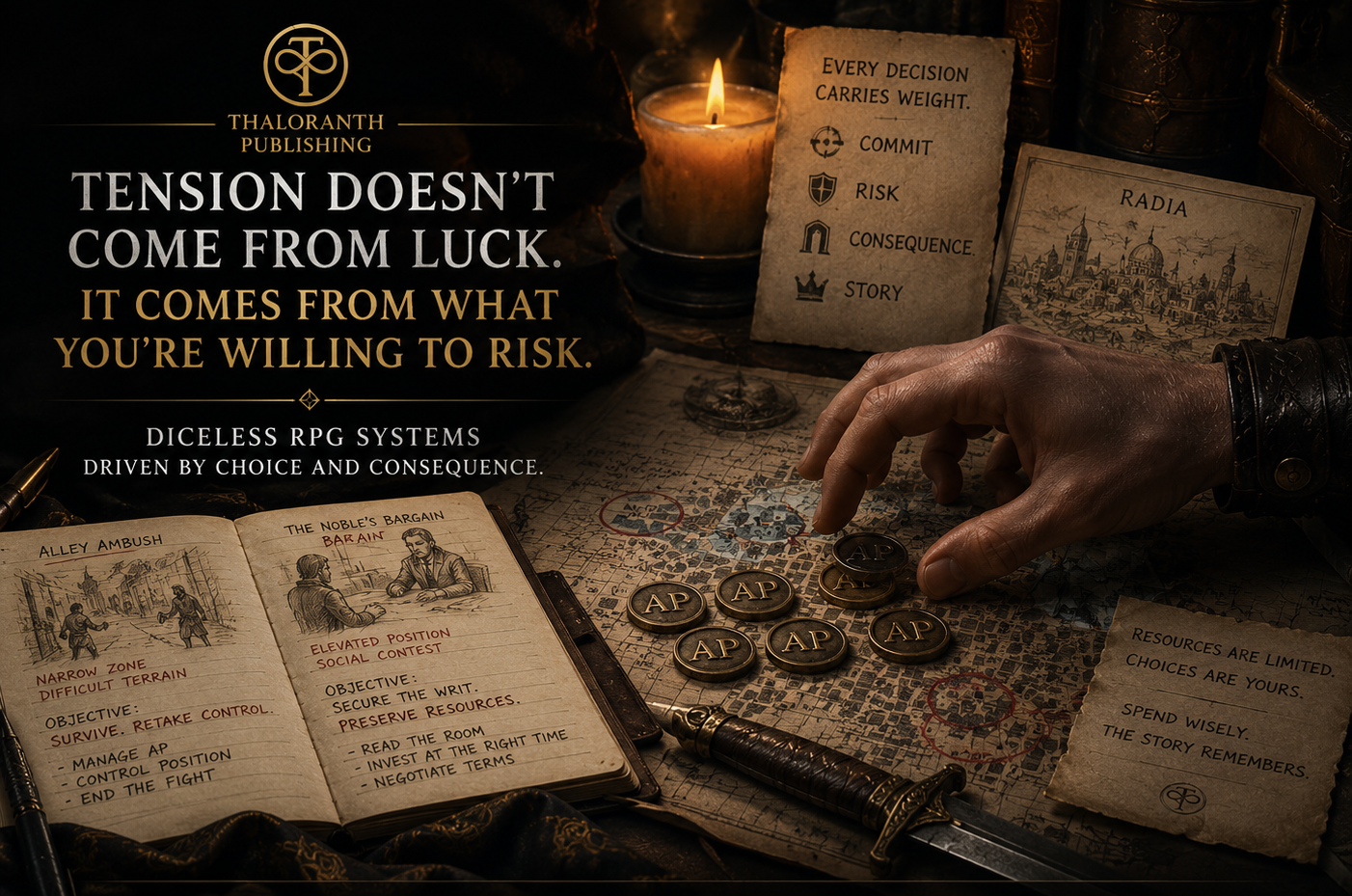
Combat Example: Alley Ambush in Radia
The easiest way to understand how Legends of Thaloranth creates tension is to see the system in action.
Imagine two adventurers making their way through one of Radia’s narrow back streets after completing a routine investigation. The alley is cluttered with broken crates, muddy puddles, and scattered debris, making movement more difficult than usual. Before they can reach the main road, three hired thugs step from the shadows and block their escape.
Kael begins the fight with 14 Action Points, while Sira has 10. Both know those resources must last for the entire scene.
Confident that ending the fight quickly will prevent the attackers from surrounding them, Kael commits 4 Action Points to a powerful opening attack against the nearest thug. The investment pays off. The strike drives the attacker backward into an adjoining courtyard, briefly disrupting the group’s formation and giving the heroes room to maneuver.
Sira chooses a different approach. Wanting to preserve resources for whatever may happen next, she spends only 1 Action Point while attempting to reposition and throw a dagger. The effort falls short, allowing one of the remaining thugs to close the distance before she can regain her footing. Suddenly, she must spend an additional 2 Action Points simply to defend herself and avoid being overwhelmed.
By the middle of the encounter, Kael has already spent nearly half of his available resources, while Sira has used three of her ten Action Points without gaining the advantage she hoped for. The remaining attackers continue pressing forward, forcing both players to evaluate the situation once again. Should Kael spend even more resources to finish the fight immediately, or should he conserve what remains in case greater danger lies ahead?
No one at the table is waiting to see what a die will decide.
The tension comes from watching limited resources disappear while knowing that every decision made now will shape the rest of the encounter.
Social Example: The Noble’s Bargain
The same principles apply outside combat.
A group of adventurers needs a writ of passage from Lord Caelen to enter a restricted warehouse district within Radia. The noble is willing to listen, but he has little reason to trust strangers who arrive asking for favors. Gaining his cooperation will require more than simply making a convincing argument.
The party’s diplomat opens the discussion cautiously, committing only a modest amount of effort while presenting the group’s request. The noble listens politely but remains unconvinced.
“An interesting proposal,” he replies, “but these documents are not given to just anyone.”
Recognizing that the conversation is slipping away, another member of the party decides the opportunity is too important to lose. This time, they commit additional Action Points while revealing information about a rival noble house that demonstrates both credibility and value.
The discussion changes immediately.
Lord Caelen agrees to provide the writ, but not without asking something in return.
“Very well,” he says. “You shall have the documents you seek. In exchange, you will deliver a sealed package to one of my associates at the docks tomorrow evening. Ask no questions, break no seals, and speak of this conversation to no one.”
The characters achieve their immediate objective, but their success introduces a new obligation that will influence future scenes. The conversation did not succeed because fortune happened to favor the players. It succeeded because they recognized when the situation demanded a greater commitment and accepted the consequences that followed.
Whether the characters are fighting in a crowded alley or negotiating in a noble’s private study, the underlying principle remains the same. Every meaningful decision requires an investment, and every investment shapes the story that follows.
Control vs. Chaos
More Control Does Not Mean Less Challenge
One of the most common concerns about diceless tabletop RPGs is that giving players greater control over their actions must also make the game easier. If the outcome is no longer determined by a die roll, it is natural to wonder whether the challenge disappears along with the randomness.
In practice, the opposite is often true.
Legends of Thaloranth does not remove uncertainty by making success automatic. Instead, it removes uncertainty that exists purely for the sake of chance and replaces it with uncertainty rooted in player decisions. The obstacles remain just as difficult, the stakes remain just as meaningful, and poor judgment can still lead to serious consequences. What changes is that players understand why those consequences occur.
A difficult encounter is still difficult. A dangerous enemy remains dangerous. A tense negotiation can still fall apart. The difference is that players are responding to the situation before them rather than hoping probability happens to work in their favor.
Players Control Their Decisions, Not the Outcome
Having greater control over a character’s decisions should never be confused with controlling the story itself.
Players decide how much effort they invest, which opportunities they pursue, and which risks they are willing to accept. They do not control how the world responds to those decisions. An enemy may prove stronger than expected. A trusted ally may reveal hidden motives. An important opportunity may come at a greater cost than anyone anticipated.
Those uncertainties continue to shape every adventure, ensuring that no two scenes unfold exactly the same way.
This balance between player agency and an unpredictable world is one of the defining characteristics of Legends of Thaloranth. Players feel responsible for their successes because those successes grow from thoughtful decisions. They also understand their setbacks because those setbacks grow from the same process. The world remains challenging, but the challenge comes from navigating meaningful situations rather than overcoming arbitrary chance.
That distinction may seem subtle at first, yet it fundamentally changes how players experience the game. Instead of celebrating because the dice happened to be kind, they celebrate because their planning, judgment, and willingness to commit at the right moment made the difference.
Failure Still Exists
Failure Comes from Your Choices
One of the most common objections to diceless tabletop RPGs is a simple one.
“Without dice, how do you ever fail?”
The answer is just as simple, failure comes from the same place success does: your decisions.
Players can still underestimate an encounter, commit too few Action Points when the situation demands more, exhaust their resources too early, make poor tactical choices, or simply choose the wrong moment to press the advantage. None of those situations require random chance because they are the direct result of the choices made throughout the scene.
Failure remains every bit as real as it is in a traditional tabletop RPG. The difference is that players usually understand why it happened. Instead of wondering whether the dice simply turned against them, they can identify the decisions that shaped the outcome and use that experience to approach future challenges differently.
Failure Changes the Story
In Legends of Thaloranth, failure is rarely final.
A failed check does not freeze the scene or prevent the adventure from continuing. Instead, it changes the situation. A guard becomes suspicious. A noble demands greater concessions before offering assistance. An enemy gains the initiative. The environment itself may become more dangerous as the pressure increases.
As explained in What a Scene Looks Like in Legends of Thaloranth, scenes are designed to move the story forward regardless of the immediate outcome. Success changes the direction of the narrative, but failure does as well. The characters may not achieve exactly what they hoped, yet the world continues to respond to their actions in meaningful ways.
That approach transforms failure from a random interruption into a natural consequence of player decisions. Rather than stopping the adventure, it creates new challenges, new opportunities, and new stories waiting to unfold.
Pacing and Flow
Faster Decisions Keep the Story Moving
One of the most noticeable differences players experience in diceless tabletop RPGs is the pace of play. Without the constant cycle of rolling dice, calculating modifiers, and checking results, scenes tend to move more naturally from one decision to the next. The focus remains on what the characters are doing instead of the mechanics required to resolve every action.
That does not mean the game lacks tactical depth. On the contrary, players still pause to consider their options, weigh the risks, and decide how many Action Points they are willing to commit. The difference is that once those decisions are made, the story continues immediately. There is no interruption while everyone waits to see what the dice have to say.
The result is a rhythm that feels more like a conversation and less like a sequence of mechanical steps. Each decision leads naturally to the next, allowing scenes to build momentum without unnecessary pauses.
Immersion Replaces Mechanical Busywork
Because players spend less time resolving mechanics, they spend more time engaging with the world around them. Conversations flow without being interrupted by repeated checks. Combat remains focused on tactics and positioning rather than a series of individual attack rolls. Investigations develop through observation, deduction, and meaningful choices instead of repeated attempts to beat a target number.
This approach keeps players immersed in the fiction. The mechanics remain important, but they support the story rather than competing with it for attention. Every decision has weight, yet the narrative continues to move forward at a steady pace.
For many groups, this creates one of the most satisfying aspects of Legends of Thaloranth. Sessions spend less time resolving the rules and more time exploring the world, developing characters, and telling memorable stories. The result is smoother pacing, stronger narrative flow, and a game that remains engaging from the opening scene to the closing moments of the adventure.
Who Diceless Tabletop RPGs Are For
A Different Style of Roleplaying
No roleplaying game is designed to appeal to every player, and diceless tabletop RPGs are no exception. Every system emphasizes different strengths, encourages different styles of play, and attracts players looking for a particular kind of experience. Legends of Thaloranth embraces that reality rather than trying to be all things to all people.
If you enjoy carefully weighing your options, managing limited resources, and watching your decisions shape the direction of the story, you’ll likely feel at home with this system. Every scene asks players to think ahead, evaluate the situation, and accept the consequences of the choices they make. Success feels earned because it grows from thoughtful planning, while failure becomes an opportunity to adapt rather than something blamed on bad luck.
For many players, that sense of ownership becomes one of the most rewarding aspects of the game. Victories belong to the people around the table because they created them through their decisions, not because probability happened to smile in their favor.
It Isn’t the Right Fit for Everyone
That said, there is nothing wrong with enjoying traditional dice-based roleplaying games.
Some players genuinely love the excitement of rolling a natural twenty at exactly the right moment or watching an unlikely success completely change the direction of an adventure. Others enjoy the unpredictability that random chance introduces, even when it occasionally disrupts the best-laid plans. Those experiences have been part of tabletop gaming for decades, and they continue to create memorable stories for countless groups.
Legends of Thaloranth simply offers a different experience.
Instead of asking players to hope the dice cooperate, it asks them to rely on strategy, resource management, and meaningful decision-making. That philosophy appeals most strongly to players who want their choices to remain the driving force behind every scene.
Being honest about that distinction is important. Legends of Thaloranth was never intended to replace every roleplaying game. It was created for players who want a diceless tabletop RPG where planning matters, consequences feel fair, and every meaningful decision helps shape the story that unfolds.
The Big Shift
From Luck to Meaningful Decisions
Everything discussed throughout this article comes down to a single philosophical shift.
Traditional tabletop RPGs often place the final outcome of an action in the hands of chance. Players develop strategies, build memorable characters, and make thoughtful plans, but at any moment the dice can change the direction of the story. That unpredictability has been part of the hobby for decades, and for many groups it remains an important part of the experience.
Legends of Thaloranth asks a different question.
What happens when the outcome depends less on luck and more on the decisions players make throughout a scene?
Instead of hoping for a favorable roll, players evaluate the situation before them, consider the resources they have available, and decide exactly how much they are willing to commit. Every choice carries a cost. Every investment has consequences. Success and failure are no longer determined by probability alone, but by the judgment, planning, and priorities of the people sitting around the table.
That single change transforms the way the game feels. Victories become deeply satisfying because they reflect decisions that proved successful. Setbacks feel fair because players can usually understand how circumstances reached that point. The story remains unpredictable, but its direction is shaped by meaningful choices rather than by random chance alone.
A Different Kind of Roleplaying Experience
That philosophy influences every part of Legends of Thaloranth. It is why scenes, rather than rounds, form the foundation of play. It is why Action Points create meaningful choices instead of simply measuring endurance, it is also why combat, social encounters, and exploration all rely on the same core principles. Every mechanic exists to support the idea that player decisions should drive the story forward.
As you’ve seen throughout this series, that philosophy extends well beyond a single rule or mechanic. If you’ve already explored What a Scene Looks Like in Legends of Thaloranth or Social Encounters That Actually Matter in Legends of Thaloranth, you’ve already seen how this approach shapes every aspect of the game. Each article examines a different piece of the system, but together they reveal a consistent design philosophy centered on meaningful choices and lasting consequences.
Ultimately, diceless tabletop RPGs are not about removing dice for the sake of being different. They are about creating a style of play where the most memorable moments grow naturally from the decisions players make. For groups looking for a roleplaying experience built on strategy, consequence, and player agency, that shift can be both refreshing and deeply rewarding.
Continue Your Journey
Ready to experience Legends of Thaloranth for yourself?
If you’re just beginning your journey, these articles provide the perfect starting point:
- What Is Legends of Thaloranth?
- What a Scene Looks Like in Legends of Thaloranth
- Social Encounters That Actually Matter in Legends of Thaloranth
- Creating a Character in 15 Minutes in Legends of Thaloranth
When you’re ready to dive deeper into the game, explore the core books:
Prefer a printed edition? Many Legends of Thaloranth titles are also available through Lulu, making it easy to build your collection in the format you enjoy most.
Whether you play solo, gather around a table with friends, or combine both styles in an ongoing campaign, Legends of Thaloranth offers a consistent, decision-driven roleplaying experience where every scene matters and every choice helps shape the story.
Leave a Reply
You must be logged in to post a comment.