The Problem With Rounds
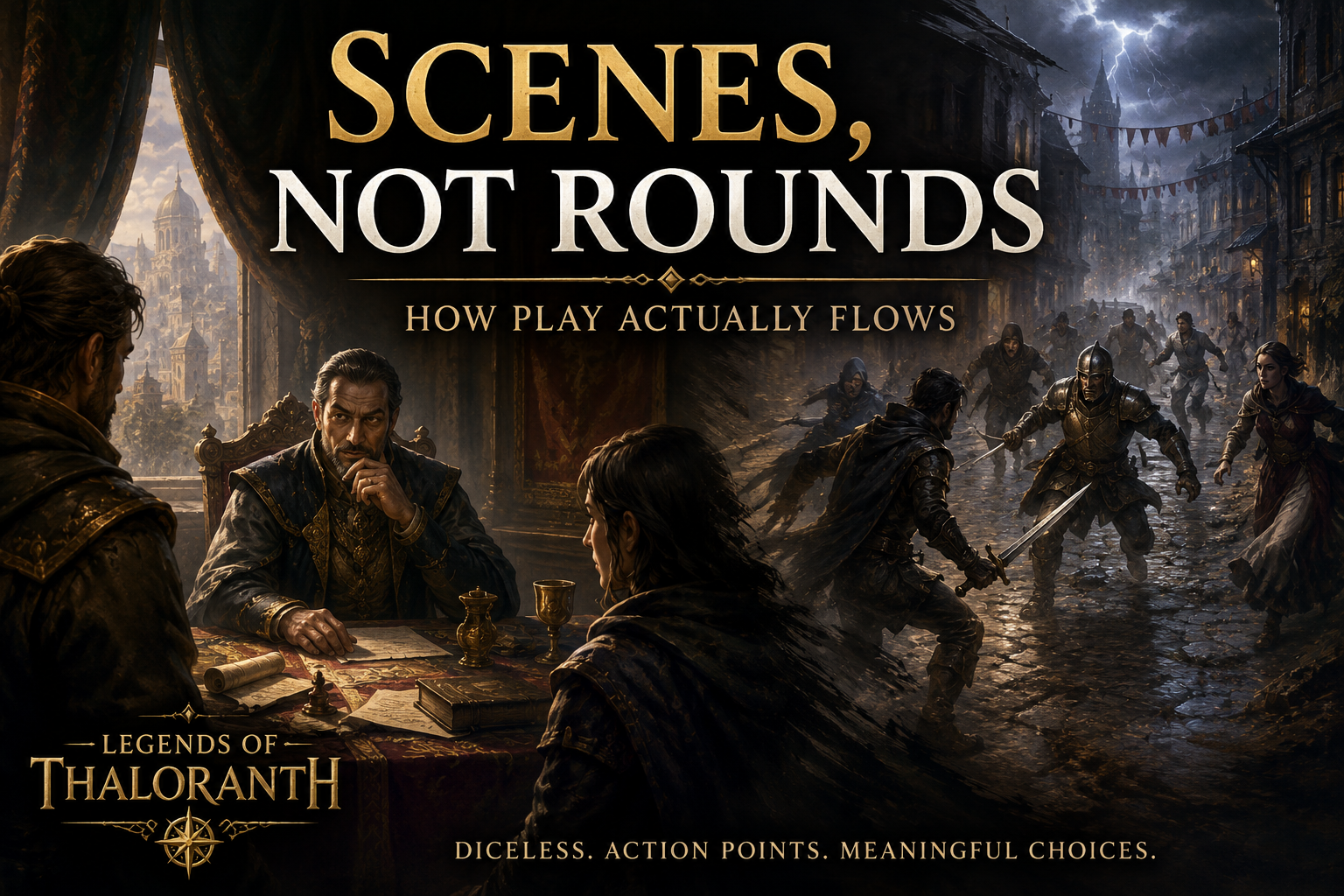
Most tabletop roleplaying games are built around rounds. Even when players are not consciously thinking about them, rounds quietly shape how a game feels, how tension develops, and ultimately, how play actually flows at the table. Scenes, not rounds, is one of the core philosophies behind Legends of Thaloranth, and the difference fundamentally changes how the game unfolds.
Combat becomes a sequence of turns. Conversations often shrink into isolated mechanical resolutions. Exploration becomes fragmented into discrete moments of pass or fail. Over time, players stop thinking in terms of dramatic moments and begin thinking in terms of actions, turns, and optimization.
Legends of Thaloranth approaches this differently.
At the heart of the system is a simple but important philosophy:
Scenes, not rounds.
If you’re new to the system, it may help first to read What Is Legends of Thaloranth?, where we explore the philosophy behind the game’s diceless, Action Point–driven design.
That distinction may sound subtle at first, but it fundamentally changes pacing, tension, and the rhythm of play itself. Instead of breaking dramatic moments into rigid intervals, Legends of Thaloranth structures gameplay around scenes, meaningful stretches of pressure, conflict, discovery, or consequence that unfold naturally rather than according to an invisible clock.
That shift matters more than many people realize.
The structure of a game quietly teaches players what the game believes is important. When a system breaks time into rigid intervals—whether six seconds, ten seconds, or initiative order—it naturally pushes attention toward what can be accomplished within those limits. Players begin asking questions shaped by the mechanics themselves:
What can I do on my turn?
How many actions do I have left?
Can I maximize efficiency before the round ends?
There is nothing inherently wrong with that style of play. Many systems are intentionally designed around tactical sequencing, positional precision, and moment-to-moment action management. For groups who enjoy carefully optimizing movement, counting actions, and navigating tightly structured encounters, round-based play can be deeply satisfying.
But that structure comes with consequences.
Drama rarely unfolds in clean six-second increments.
A desperate negotiation with a suspicious noble does not happen in neatly segmented turns. A tense chase through crowded streets does not pause every few moments so each participant can calmly calculate their next move. A crumbling ruin does not collapse according to initiative order while everyone patiently waits for their turn to react.
Real dramatic pressure escalates unevenly. It surges, stalls, changes direction unexpectedly. Stakes rise as new information emerges, emotions shift, and circumstances evolve.
Round-based systems often struggle to capture that feeling because they are built to prioritize procedural fairness over dramatic flow. The result is a subtle fragmentation of tension. Moments that should feel immediate and emotionally charged become broken apart into small mechanical transactions.
A dramatic battle can slowly transform into an exchange of isolated actions.
Meaningful social encounters can collapse into single moments of mechanical resolution rather than unfolding naturally as suspicion rises, leverage shifts, and emotions change.
Exploration can become reduced to whether someone succeeds or fails at a single obstacle instead of evolving into an unfolding experience shaped by mounting pressure and meaningful choices.
Over time, this shapes not only pacing, but expectation.
Players begin to view conflict through the lens of turns rather than momentum. Scenes become mechanical puzzles to solve instead of evolving moments of pressure. Even roleplaying itself can become interrupted by the constant rhythm of stop, resolve, stop, resolve.
Legends of Thaloranth starts from a different question entirely.
Instead of asking:
What happens during the next round?
It asks:
What matters in this moment?
Why Scenes Change Everything
At first glance, replacing rounds with scenes may seem like a relatively minor structural adjustment, a different way of organizing time at the table without fundamentally changing the experience of play. In practice, however, that shift changes far more than many players initially expect. It changes how tension develops, how decisions are made, and perhaps most importantly, how the game itself feels in motion.
The way a system structures time quietly teaches players what kind of thinking the game rewards. In round-based systems, attention naturally gravitates toward immediate efficiency. Players begin evaluating situations through short tactical windows, asking themselves what action is optimal during the next turn, how to maximize effectiveness before initiative cycles back around, or whether now is the right moment to expend a powerful ability. None of this is inherently problematic. For many groups, especially those who enjoy carefully structured tactical combat, this kind of play is part of the appeal.
Yet there is an unavoidable side effect to this structure. Because dramatic moments are repeatedly interrupted by mechanical pauses, tension often develops in fragments rather than as a continuous experience. Momentum advances in short bursts before stopping again for resolution, calculation, and reassessment. Even deeply emotional or dangerous moments can slowly become transformed into a sequence of isolated decisions rather than an evolving situation shaped by mounting pressure.
Scenes change that rhythm entirely.
Because scenes are built around meaningful dramatic moments rather than rigid slices of time, play begins to flow differently. Conversations are allowed to evolve naturally as emotions shift and priorities change. Conflict escalates in ways that feel less procedural and more organic. Exploration becomes something that unfolds through mounting uncertainty rather than a series of disconnected obstacles waiting to be resolved one at a time.
A tense political conversation, for example, does not remain static. Trust erodes. Leverage changes hands. Hidden motivations reveal themselves slowly as the stakes become clearer. Likewise, a dangerous confrontation rarely stays fixed in the form it began. A battle that starts with confidence may slowly give way to desperation as resources dwindle, positioning worsens, or unexpected complications emerge. Even travel transforms under a scene-based structure, becoming less about isolated moments of success or failure and more about sustained pressure, exhaustion, risk, and difficult decision-making over time.
What makes this approach especially powerful in Legends of Thaloranth is the relationship between scenes and Action Points.
Because Action Points only refresh at the end of a scene, players are constantly weighing not merely what matters right now, but what may still lie ahead. We explored the role of Action Points more deeply in Action Points: The Core of Every Decision, but scene structure is what gives those decisions their long-term weight.
Because Action Points only refresh at the end of a scene, players are constantly weighing not merely what matters right now, but what may still lie ahead. Decisions gain a broader context. The question is no longer simply whether an action is worth the investment in this immediate moment, but whether spending heavily now may leave a character vulnerable if the situation escalates further before resolution arrives.
This creates a different kind of uncertainty than traditional randomness.
Instead of wondering whether luck will intervene at the perfect moment, players begin wondering whether their judgment was sound. Did they commit too heavily too soon? Did they preserve too much and miss an opportunity to seize control? Will the conversation turn hostile? Do reinforcements arrive? Can the difficult journey become even more dangerous before safety is reached?
The pressure comes not from unpredictable mathematics, but from incomplete information and meaningful resource management.
As a result, play begins to feel more connected. Social encounters gain weight because tension has room to build. Exploration feels more immersive because danger develops over time rather than appearing as isolated interruptions. Conflict feels more dramatic because momentum is allowed to evolve naturally instead of being repeatedly divided into mechanical intervals.
Ultimately, scenes change everything because they encourage players to think less about isolated actions and more about unfolding moments. The focus shifts away from maximizing efficiency during the next turn and toward understanding the shape of the situation itself, where it is heading, what still remains unresolved, and how much one is truly willing to commit before the moment finally reaches its conclusion.
A Real Difference in Play
Philosophy matters, but examples reveal what a system actually feels like at the table.
The difference between rounds and scenes becomes much easier to understand when the same situation is viewed through both lenses. On paper, the distinction may appear subtle. In play, however, the experience feels fundamentally different.
Consider a relatively simple scenario.
The characters need access to a restricted warehouse district in Radia’s River Quarter. The only way forward is through Lord Caelen, a cautious minor noble who controls the necessary writ of passage. He is intelligent, politically connected, and deeply aware that any favor granted today may create problems tomorrow.
In many traditional round-based systems, this interaction is often resolved quickly. A persuasion attempt is made, perhaps supported by a secondary skill or roleplayed argument, followed by some form of mechanical resolution. The outcome arrives almost immediately. The characters either succeed, fail, or receive a partial concession before the story moves forward.
The scene has served its function.
But something important is often lost in that speed.
Meaningful conversations rarely unfold all at once. Suspicion grows. Trust shifts. Hidden motives surface gradually. Pressure escalates as participants learn more about one another and begin adjusting their positions accordingly.
In Legends of Thaloranth, the encounter unfolds differently because it is treated as a scene rather than a momentary obstacle.
The conversation begins cautiously. Lord Caelen listens politely but remains guarded, measuring words carefully while weighing the risks of becoming involved. The party’s diplomat chooses to commit only a modest amount of Action Points during the opening exchange, enough to establish credibility without overextending too early.
The attempt falls short.
The conversation does not end.
Instead, the scene changes.
Lord Caelen grows more cautious. Questions become sharper. Doubt enters the room. What began as a straightforward request slowly becomes a negotiation filled with uncertainty.
Recognizing the shift, another member of the party steps forward, offering carefully chosen information regarding a rival merchant house while committing more heavily to the interaction. This time, the investment succeeds, but success does not arrive cleanly.
Lord Caelen agrees to provide the writ.
At a cost.
A package must be delivered quietly to a contact at the docks tomorrow evening. No questions asked. Refusal would not merely jeopardize the favor; it would create political consequences the characters may later regret.
The scene ends, but the story expands.
The important difference here is not merely the outcome. It is the shape of the experience itself.
The interaction unfolds through mounting pressure, changing leverage, and evolving consequences rather than resolving through a single mechanical moment. Players remain engaged because decisions continue to matter throughout the scene, and tension grows naturally as uncertainty evolves.
Rounds tend to fragment dramatic moments.
Scenes allow them to develop.
Why Scenes Work Especially Well for Solo Play
One of the greatest strengths of a scene-based structure is how naturally it supports solo play.
Many traditional tabletop systems were never truly designed with solo play in mind. Even when solo tools are added later through supplements, random tables, or oracle mechanics, the underlying structure of the game often remains rooted in assumptions built for group play. Combat still expects carefully managed initiative. Social encounters frequently assume a Game Master interpreting nuance. Exploration often relies on repeated mechanical resolution that can begin to feel repetitive without another player helping shape momentum.
The result is a common frustration among solo players: the system technically functions, but the experience often feels fragmented, procedural, or strangely mechanical when played alone.
Scenes solve much of this problem because they naturally encourage a different style of thinking.
Instead of asking, What happens during the next turn?, solo players begin asking broader and far more narratively meaningful questions. What is happening in this moment? Where is the pressure coming from? What changes if this situation escalates?
This creates momentum.
A solo scene develops through tension rather than rigid sequencing. A dangerous journey through the Wildlands is no longer reduced to a string of disconnected travel checks. Instead, the journey becomes a living situation shaped by changing weather, diminishing supplies, unexpected encounters, and mounting uncertainty. The scene continues for as long as meaningful pressure exists and ends only when resolution finally arrives, whether through survival, retreat, discovery, exhaustion, or catastrophe.
Social encounters benefit especially from this structure.
In many systems, solo diplomacy can become difficult because conversations often resolve too quickly or rely heavily on external interpretation. In Legends of Thaloranth, scenes naturally create room for emotional shifts, changing leverage, and evolving stakes. A conversation with a suspicious merchant, rival knight, or political ally unfolds gradually. Information changes the situation. Commitments matter. Pressure rises and falls depending on choices made during the interaction.
The scene itself becomes dynamic.
Combat also gains something important in solo play: sustained tension.
Because Action Points refresh only at the end of a scene, players are forced to think beyond immediate success. Winning the first exchange may matter far less than surviving whatever escalation still waits ahead. A fight that initially appears manageable may become dangerous as new enemies emerge, positioning changes, or resources begin running dangerously low.
This creates an experience that feels less like solving isolated mechanical problems and more like navigating an unfolding situation.
For solo players especially, this distinction matters.
Without another person at the table helping maintain momentum, pacing becomes one of the most important qualities any system can possess. Scenes provide that momentum naturally because they focus attention on dramatic pressure instead of procedural repetition. The question is never simply whether the current action succeeds or fails.
The real question becomes:
What is this moment becoming?
Why Scenes Help Game Masters Too
Scene-based play changes more than the player experience. It fundamentally alters how Game Masters approach pacing, tension, preparation, and the overall rhythm of a session. While much of the discussion around rounds and scenes naturally focuses on what players experience at the table, the structural difference often becomes even more noticeable behind the screen.
In many traditional systems, Game Masters find themselves balancing competing priorities. They are responsible for maintaining dramatic momentum, escalating tension, and responding meaningfully to player decisions, yet they are also frequently required to manage procedural mechanics that can interrupt the very pacing they are attempting to preserve. Initiative order must be tracked. Turns must be resolved.
Repeated mechanical checks often slow moments that, narratively speaking, should feel immediate or emotionally charged.
This challenge becomes especially noticeable during moments meant to feel dynamic or uncertain.
A dangerous confrontation may begin with strong momentum, only to slow beneath repeated cycles of turn management and resolution. Social encounters that should feel fluid and emotionally responsive can become interrupted as mechanics repeatedly step between players and the fiction. Exploration, particularly during travel or investigation, may lose a sense of mounting tension as meaningful moments become divided into isolated tasks rather than unfolding naturally as part of a larger dramatic experience.
Scene-based play offers a different rhythm because it allows Game Masters to think less in terms of sequencing and more in terms of escalation.
Instead of constantly focusing on whose turn comes next or how many actions remain within a given timeframe, attention shifts toward more meaningful questions. What pressures currently define the moment? How are circumstances changing? What complications make sense as the situation evolves? Where is the tension naturally leading?
This shift often creates a smoother and more intuitive style of Game Mastering because dramatic momentum no longer competes with procedural structure.
A confrontation does not remain static simply because initiative has begun. New complications can emerge naturally. Reinforcements may arrive. Terrain can shift as environmental dangers intensify. A social encounter can become more dangerous as hidden motives surface or alliances begin to fracture. A negotiation can move from diplomacy to veiled threats without feeling as though the game itself must pause to catch up with the fiction.
Improvisation also becomes considerably easier under a scene-based structure.
Because scenes are built around pressure and consequence rather than rigid sequencing, unexpected player decisions become easier to absorb without disrupting the overall flow of play. Players may abandon negotiation in favor of deception, transform an investigation into a pursuit, or completely redirect the focus of a situation through an unanticipated decision. The Game Master does not need to reconstruct the encounter from the ground up. Instead, the scene simply evolves. Pressure shifts. Stakes change. Consequences emerge.
For campaigns shaped heavily by player agency, this flexibility becomes invaluable because the most memorable moments rarely occur exactly as planned.
Preparation changes as well.
Instead of preparing tightly controlled encounters that assume a predictable sequence of actions, Game Masters begin preparing situations. The focus moves toward understanding what pressures exist, what factions or individuals want, what complications may emerge, and how consequences might unfold depending on player decisions. The result often feels less rigid while simultaneously creating stronger dramatic consistency.
Perhaps most importantly, scene-based play reduces the quiet mechanical fatigue that can accumulate over long sessions. Less energy becomes devoted to maintaining procedures that contribute little to dramatic tension, while more attention remains focused on evolving circumstances, meaningful decisions, and the shared momentum of the story itself.
For many Game Masters, the result feels less like struggling to preserve drama despite the structure of play and more like the structure itself naturally reinforcing the kind of pacing, escalation, and tension they were trying to create all along.
Who This Style of Play Works Best For
No tabletop roleplaying system works equally well for every kind of player, and scene-based play is no exception.
The way a game structures time inevitably shapes the experience it creates, which means different players will naturally respond to that structure in different ways. Some people thrive within tightly ordered tactical systems where precision, sequencing, and moment-to-moment optimization sit at the center of play. Others are more interested in dramatic momentum, evolving situations, and decisions that carry weight across a larger stretch of time.
Legends of Thaloranth deliberately leans toward the latter.
Because scenes replace rounds as the foundation of how play actually flows, the system tends to resonate most strongly with players who enjoy thinking in terms of unfolding situations rather than isolated actions. It rewards those who like weighing difficult choices, managing limited resources across meaningful moments, and adapting to changing circumstances as pressure gradually escalates.
Players who enjoy strategy often find scene-based play deeply satisfying, though not necessarily for the reasons they may initially expect. Strategy in Legends of Thaloranth is rarely about optimizing a single turn or identifying the mathematically strongest immediate action. Instead, it revolves around judgment, pacing, and timing. Knowing when to commit heavily and when to hold back becomes just as important as deciding what action to take in the first place.
This style of play also tends to appeal strongly to players who enjoy roleplaying and narrative immersion because dramatic moments are given room to develop rather than repeatedly pausing for mechanical interruption. Conversations evolve. Conflicts shift shape. Tension rises naturally as situations become more complicated, uncertain, or dangerous over time.
Solo players often discover that scenes feel particularly intuitive because the structure naturally supports momentum without requiring constant external input. Since scenes are driven by pressure rather than rigid sequencing, solo play often feels more organic and less procedural, allowing stories to unfold with greater flexibility while still preserving meaningful challenge.
At the same time, it is equally important to acknowledge that scene-based play will not resonate with everyone.
Players who strongly prefer highly tactical turn optimization, carefully measured positioning, or the satisfaction that comes from maximizing efficiency within tightly structured rounds may find themselves missing aspects of traditional play. Others may simply enjoy the unpredictability that comes from systems built around constant procedural resolution and tightly segmented pacing.
There is nothing wrong with that preference.
Different systems create different experiences, and much of finding the right tabletop game comes down to understanding what kind of experience feels most satisfying to the people at the table.
Legends of Thaloranth is not attempting to replace every style of play.
It is attempting to create a specific one.
A style where dramatic moments are allowed to breathe, where meaningful pressure unfolds across scenes rather than isolated turns, and where players are encouraged to think not only about what they can do right now, but what choices will still matter when the moment finally reaches its conclusion.
Conclusion: Stop Counting Seconds
The structure of a tabletop roleplaying game matters more than many players realize.
The way a system measures time quietly shapes everything that follows. It influences how tension develops, how players make decisions, how Game Masters pace dramatic moments, and ultimately how stories are remembered long after a campaign ends. Mechanics do more than resolve outcomes. They teach players what kind of thinking the game rewards.
Round-based systems ask players to think in fragments of time. What happens during the next turn? What action creates the greatest immediate advantage? How can efficiency be maximized before initiative cycles back around?
There is nothing inherently wrong with this approach. For many groups, it creates satisfying tactical play and highly structured encounters that reward careful planning and precision.
Legends of Thaloranth simply asks a different question.
Instead of measuring play through rigid intervals, it structures experience around meaningful moments of pressure, consequence, and change. Scenes become the foundation of how play actually flows because scenes mirror the way memorable stories unfold. A difficult negotiation grows more tense before reaching a resolution. A dangerous battle escalates as resources dwindle and desperation sets in. A journey becomes meaningful not because of isolated obstacles, but because pressure accumulates over time until difficult choices must finally be made.
This shift changes the feel of play in ways that are difficult to fully appreciate until experienced firsthand.
Players begin thinking less about isolated actions and more about unfolding situations. Decisions gain weight because resources must last beyond the immediate moment. Game Masters gain flexibility because tension evolves naturally rather than fighting against procedural interruption. Solo players benefit from stronger momentum because dramatic pressure becomes the engine driving play forward.
Most importantly, scenes create room for moments to breathe.
The memorable parts of tabletop roleplaying rarely happen because someone counted squares perfectly or optimized a single turn. They happen because pressure mounted, stakes changed, plans evolved, and players found themselves forced to make difficult decisions when the outcome still mattered.
That is the philosophy behind scenes, not rounds.
Stop counting seconds.
Start thinking in moments.
Because the moments players remember are never measured by initiative order.
They are measured by what was at stake when the decision finally had to be made.
Continue Exploring Legends of Thaloranth
If you enjoyed this article, continue the series:
→ What Is Legends of Thaloranth?
A complete introduction to the world, system, and philosophy behind the game.
→ Why Diceless Tabletop RPGs Work (And Why Most People Are Wrong About Them)
Why tension comes from meaningful choices rather than randomness.
→ Action Points: The Core of Every Decision
How Action Points create pressure, pacing, and strategy in every scene.
Your decisions are waiting.
Looking for something different from traditional RPG systems?
Legends of Thaloranth and Starburn Sector feature diceless, AP-driven gameplay built for meaningful choices, structured scenes, and both solo and group play.
Join the Thaloranth Review Guild to receive review copies and help shape the future of the system.
Apply here
Curious about the philosophy behind Legends of Thaloranth? Read the recent Q&A discussing the system’s design, solo play, and diceless approach.
Continue Your Journey
Legends of Thaloranth focuses on scenes rather than traditional combat rounds, creating adventures that flow like stories instead of tactical exercises. Learn how scene design, pacing, and encounter structure work together in the Game Master’s Guide, and see how players engage with these systems in the Player’s Guide.
Leave a Reply