Action Points: The Core of Every Decision in Legends of Thaloranth
What are Action Points in Legends of Thaloranth? They are far more than a resource to spend during play. They are the mechanic that transforms every important moment into a meaningful decision, replacing the uncertainty of random chance with thoughtful commitment, careful planning, and lasting consequences. Every scene asks the same simple question:
How much is this moment worth to you?
Every great tabletop roleplaying game has a mechanic that defines how it feels to play. In some games, that mechanic is a handful of dice tumbling across the table. In others, it is a deck of cards, a pool of tokens, or a carefully managed list of abilities. Those mechanics shape the rhythm of play, influence players’ decisions, and ultimately define the stories that emerge from each adventure.
For Legends of Thaloranth, that defining mechanic is the Action Point.
At first glance, Action Points appear deceptively simple. They represent a limited pool of effort that players can spend to improve important actions throughout a scene. Yet beneath that straightforward design lies the philosophy that drives the entire game. Every Action Point spent represents a conscious decision. Every investment reflects a choice about what matters most in that moment. Rather than hoping fortune smiles upon you, the game asks you to decide how much of your character’s strength, focus, and determination you are willing to commit before the outcome is known.
That single shift changes the emotional experience of play in profound ways. Instead of celebrating extraordinary luck, players celebrate extraordinary judgment. Success feels earned because it grows from deliberate choices made under pressure. Setbacks remain meaningful because they are the natural consequence of decisions rather than the disappointment of an unlucky roll. The tension never disappears—it simply comes from a different place.
If you’ve already read What Is Legends of Thaloranth?, you’ve seen how meaningful decisions shape every aspect of the game’s design. Action Points are where that philosophy becomes reality. They are the bridge between the ideas behind the system and the moment-to-moment choices that define every adventure.
In this article, we’ll explore what Action Points represent, how they work, why their scene-based design creates such powerful tension, and how mastering them changes the way you approach every challenge. By the end, you’ll understand why Action Points are not simply another game mechanic—they are the heart of Legends of Thaloranth.
More Than a Resource
What Action Points Represent
At first glance, Action Points may look like another resource to manage. Many roleplaying games use points to fuel special abilities, cast spells, or activate powerful techniques. While Action Points can certainly be used in those ways, they were never intended to function as just another pool of expendable points.
In Legends of Thaloranth, Action Points represent your character’s willingness to push beyond the ordinary. They measure the extra effort, unwavering focus, and determined commitment required when success truly matters. Every point spent reflects a conscious decision to invest more of yourself into the challenge before you.
That distinction changes the way players think about the game. Rather than asking, “Can I afford to use this ability?” they begin asking a far more meaningful question:
“Is this moment important enough to deserve more of my effort?”
That shift transforms Action Points from a mechanical currency into a storytelling tool. Every expenditure reflects the importance of the moment, helping players express not only what their characters do, but how much those actions matter.
Every Point Represents a Choice
Because Action Points are limited, spending them is never automatic.
Every point invested in an attack is one that cannot strengthen your defense later in the scene. Every point committed during a tense negotiation may leave fewer options if the conversation suddenly takes an unexpected turn. Even choosing not to spend Action Points is a decision, preserving your resources for challenges that may lie ahead.
This constant balancing act creates meaningful tension without relying on random chance. Instead of waiting to see whether the dice cooperate, players actively weigh risk against reward, deciding exactly how much they are willing to commit before acting.
If you’ve already read Why Diceless Tabletop RPGs Work, you’ve seen how meaningful decisions replace random outcomes. Action Points are the mechanic that makes that philosophy possible, giving players direct control over the choices that shape every scene.
The Foundation of Every Scene
Action Points are woven into every part of Legends of Thaloranth. Whether you’re crossing blades with a seasoned mercenary, persuading a skeptical magistrate, searching an abandoned temple for forgotten knowledge, or helping an ally overcome a seemingly impossible obstacle, the same resource drives every meaningful decision.
That consistency is one of the system’s greatest strengths. Players don’t learn one mechanic for combat, another for diplomacy, and a third for exploration. Instead, they learn a single decision-making framework that applies throughout the game. Once you understand Action Points, you begin to understand the rhythm of Legends of Thaloranth itself.
In the next section, we’ll look at how Action Points function during play and why their scene-based design creates the unique pacing that defines every adventure.
Understanding Action Points
Building Your Action Point Pool
Every character in Legends of Thaloranth begins each scene with a pool of Action Points (AP). That pool represents the extra effort, focus, and determination your character can draw upon when success truly matters.
The size of your Action Point pool is based on two of your core attributes:
(Power + Agility) × 2
While the formula itself is simple, its impact is significant. Characters with greater physical capability and agility naturally possess larger reserves, allowing them to sustain their efforts longer during demanding scenes. As those attributes improve over the course of a campaign, so too does the number of Action Points available, reflecting a hero whose experience has translated into greater endurance, confidence, and control.
Unlike many RPG resources that fluctuate throughout the adventuring day, Action Points are designed around individual scenes. That decision keeps every encounter focused on the drama unfolding in the moment rather than encouraging players to conserve resources for events that may never happen.
Spending Action Points
Action Points can be spent whenever a character wants to improve an important action. The most common use is straightforward: every Action Point spent adds +1 to the total of a check before it is compared against the Difficulty Class. That transparency gives players direct control over the outcome, allowing them to decide exactly how much effort they wish to invest.
Beyond improving checks, Action Points can also increase damage, strengthen defenses, enhance movement between zones, support allies, activate special abilities, and fuel many of the unique features found throughout the game. Regardless of how they’re used, every expenditure follows the same guiding principle.
Every Action Point spent represents a conscious decision.
Because the same resource supports combat, exploration, social encounters, and magic, players are constantly weighing priorities instead of managing separate pools for different situations. The result is a system that remains both flexible and remarkably easy to learn.
A System Built on Consistency
One of the greatest strengths of Action Points is that they function the same way throughout the entire game. Whether you’re climbing a crumbling watchtower, persuading a reluctant noble, casting a powerful spell, or fighting for your life against a band of raiders, the same core mechanic remains at work.
That consistency means players spend less time learning new rules and more time making meaningful decisions. Once the Action Point system becomes familiar, every new challenge builds upon knowledge they already possess, allowing the mechanics to fade into the background while the story takes center stage.
If you’d like to see how this philosophy shapes every aspect of the system, What Is Legends of Thaloranth? explores the design principles that unite the game’s mechanics into a single, decision-driven experience.
Why Scene-Based Refresh Changes Everything
Every Scene Becomes Its Own Story
One of the most distinctive features of Legends of Thaloranth is that Action Points refresh at the end of each scene, not after every round, every encounter, or at the Game Master’s discretion. That single design choice transforms the rhythm of play in ways that aren’t immediately obvious until you experience it at the table.
Each scene becomes a complete dramatic experience with its own beginning, rising tension, climax, and resolution. Whether the characters are negotiating with a suspicious merchant, defending a village from raiders, or searching the ruins of an ancient temple, every decision draws from the same limited pool of Action Points. As those resources begin to dwindle, the pressure naturally increases, creating tension that players can feel without relying on random chance.
If you’re unfamiliar with the scene-based structure, What a Scene Looks Like in Legends of Thaloranth explores how scenes provide the foundation for every adventure.
Every Point Spent Closes Another Door
Action Points become meaningful because they are limited.
Every point invested in one action is a point that cannot be spent somewhere else later in the scene. Commit heavily to overwhelm an opponent now, and you may find yourself with fewer options if reinforcements arrive. Spend everything persuading a reluctant noble, and you may have little left when the conversation takes an unexpected turn.
This is known as opportunity cost, and it lies at the heart of every meaningful decision in Legends of Thaloranth.
Players are constantly balancing immediate rewards against future uncertainty. They know exactly what they can accomplish today, but they never know precisely what challenges the remainder of the scene may hold. That uncertainty creates dramatic tension because every investment carries visible consequences.
Rather than asking whether luck will save them, players begin asking a different question:
“Is this the right moment to commit?”
Decisions Replace Random Chance
This is where Action Points become more than a resource, they become the mechanical expression of the game’s philosophy.
Traditional roleplaying games often place the final outcome of important actions in the hands of probability. Legends of Thaloranth places that responsibility in the hands of the players instead. Every Action Point spent represents a deliberate decision about what matters most, allowing success and failure to grow naturally from commitment, judgment, and timing rather than from fortunate dice rolls.
That doesn’t make the game easier.
It makes every decision more meaningful.
If you’d like to explore this philosophy in greater depth, Why Diceless Tabletop RPGs Work explains how replacing random chance with meaningful decisions creates a different, but equally compelling, kind of dramatic tension.
The Rhythm of Every Adventure
Because Action Points refresh when a scene ends, every adventure develops a natural rhythm. Players begin each scene with possibility, gradually commit more of their resources as challenges intensify, and eventually reach a point where every remaining Action Point feels precious. When the scene concludes, the story moves forward, resources are restored, and a new dramatic chapter begins.
That rhythm creates campaigns that feel both structured and organic. Players instinctively recognize when a scene is building toward its climax because they can see their remaining resources shrinking. The mechanics reinforce the narrative, allowing tension to emerge naturally from the decisions made throughout the scene instead of being imposed by chance.
It is a remarkably simple idea.
Yet that single design choice changes the way every adventure unfolds.
Action Points in Play
Combat Example: Holding the Bridge
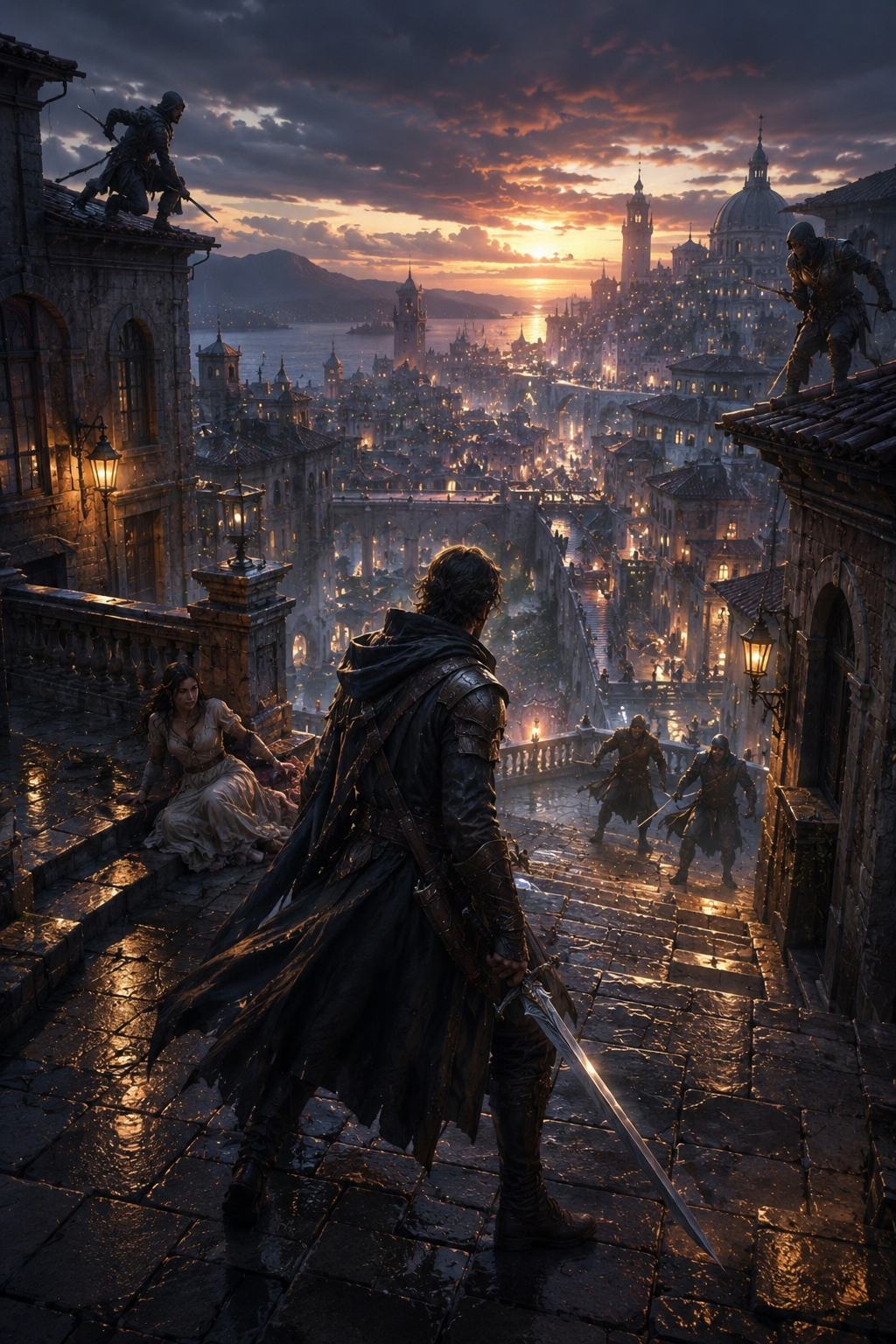
Imagine a small party attempting to hold a narrow stone bridge while villagers escape across the river behind them. Three heavily armed raiders advance from the opposite bank, knowing that breaking through the defenders will leave the fleeing villagers with nowhere to run.
Kael, a seasoned warrior, begins the scene with 14 Action Points. He immediately faces a difficult decision. Should he spend heavily to stop the raiders before they gain momentum, or conserve his resources in case the fight lasts longer than expected?
He chooses to commit.
Spending several Action Points, Kael launches a powerful opening attack that drives the lead raider backward and blocks the narrow approach. The gamble succeeds, buying precious time for the villagers to continue their escape.
The remaining raiders regroup and press forward. As the battle continues, Kael’s pool of Action Points steadily shrinks. Every defensive maneuver and every powerful strike forces him to ask the same question:
Is this the moment worth another investment?
By the final exchange, only a handful of Action Points remain. Victory is still possible, but every decision carries far greater weight than it did when the battle began.
The tension isn’t created by wondering what the dice might decide.
It’s created by deciding how much you are willing to commit before the scene reaches its climax.
Social Example: Winning the Council’s Trust
Action Points influence conversations just as dramatically as combat.
The party has been invited before Radia’s Merchant Council to request funding for an expedition into the Wildlands. The council members are interested, but cautious. They have financed failed expeditions before, and convincing them to invest again will require more than an enthusiastic speech.
The group’s spokesperson begins carefully, spending only a small number of Action Points while presenting the expedition’s goals. The council listens politely but remains unconvinced.
Recognizing that the opportunity may be slipping away, another character steps forward with detailed maps, trade projections, and evidence gathered during previous adventures. This time, they commit additional Action Points to strengthen the presentation.
The discussion changes immediately.
Questions become conversations. Skepticism becomes curiosity. By the end of the meeting, the council agrees to provide financial support, but only after the party accepts several conditions that will influence future adventures.
Just as in combat, success grows from thoughtful decisions rather than fortunate rolls. The players chose when to conserve their resources, when to invest heavily, and when the moment truly deserved their full commitment.
One System, Endless Possibilities
Although these examples take place in very different situations, they rely on exactly the same mechanics. Combat, diplomacy, exploration, investigation, and countless other challenges all ask players the same question:
How much is this moment worth to you?
That consistency is one of the defining strengths of Legends of Thaloranth. Players do not learn separate systems for different parts of the game. Instead, they learn a single approach to decision-making that applies no matter where the story leads.
Whether you’re defending a bridge, negotiating with a council, exploring forgotten ruins, or protecting a kingdom from invasion, every Action Point spent reflects a deliberate choice—and every choice helps shape the story that follows.
Thinking Like a Veteran Player
Learn to Read the Scene
New players often spend Action Points reactively. An important check appears, so they invest just enough to succeed. Another challenge follows, and they do the same again. While that approach works, it rarely takes full advantage of the system’s strategic depth.
Experienced players approach each scene differently.
Before committing their resources, they evaluate the situation as a whole. They consider the environment, the objectives, the people involved, and the obstacles that may still lie ahead. Rather than asking only, “Can I succeed?” they begin asking, “Where is this scene most likely to reach its turning point?”
That shift in perspective changes everything. By recognizing which moments truly matter, veteran players learn when patience creates opportunity and when decisive action is the better choice.
Commit with Purpose
Every scene contains moments that deserve your full commitment.
Sometimes it’s the opening exchange of a battle, where seizing the initiative can shape everything that follows. Other times it’s the final argument in a difficult negotiation, the desperate leap across a collapsing bridge, or the decision to trust someone whose loyalty remains uncertain.
The key is not spending Action Points freely or hoarding them until the scene ends.
The key is recognizing the moment that will have the greatest impact on the story and committing confidently when that moment arrives.
Action Points reward thoughtful judgment just as much as bold action. Players who learn that rhythm soon discover that the game feels less like managing a resource and more like directing the flow of the story itself.
If you’d like to see how this philosophy changes combat, How Combat in Legends of Thaloranth Flows explores the tactical decisions that emerge when every Action Point matters.
Every Decision Shapes the Story
The longer people play Legends of Thaloranth, the less they think about Action Points as numbers on a character sheet.
Instead, they begin thinking about choices.
Should they press the attack or protect an ally? Continue negotiating or accept an uneasy compromise? Explore one more chamber or preserve their strength for whatever lies beyond the next doorway?
Those decisions become the stories players remember long after the campaign has ended because they belong entirely to them. Every triumph reflects thoughtful planning. Every setback creates new opportunities to adapt, overcome, and continue the adventure.
That is what Action Points were designed to accomplish.
Not simply to replace dice.
But to ensure that the most memorable moments in every campaign grow naturally from meaningful decisions.
Continue Your Journey
If you’d like to explore the ideas behind Action Points in greater depth, these articles are the perfect next step:
- What Is Legends of Thaloranth?
- Why Diceless Tabletop RPGs Work
- What a Scene Looks Like in Legends of Thaloranth
- How Combat in Legends of Thaloranth Flows
- Social Encounters That Actually Matter in Legends of Thaloranth
When you’re ready to experience the system for yourself, the Player’s Guide contains everything you need to begin playing, while the Game Master’s Guide expands the experience with tools, advice, and resources for creating memorable adventures. Together, they provide the complete foundation for exploring the world of Vaeloraranth and the growing Legends of Thaloranth product line.
Whether you prefer digital books or printed volumes on your gaming shelf, many Legends of Thaloranth titles are also available through Lulu, making it easy to build your collection in the format that best fits your table.
Every scene begins with a question.
How much is this moment worth to you?
Now it’s your turn to answer.
Leave a Reply
You must be logged in to post a comment.