Every great game has one central mechanic that defines how it feels at the table.
In chess, it’s positioning. In poker, it’s reading people and managing risk.
In Legends of Thaloranth, that defining mechanic is Action Points.
Action Points are not just a resource. They are the beating heart of the entire system, the place where philosophy meets gameplay, where abstract ideas about player agency become concrete, moment-to-moment decisions.
If you want to truly understand why Legends of Thaloranth feels different from almost every other RPG on the market, you have to understand Action Points. Not just how they work mechanically, but what they do to the way the game is played, and the way players think.
Most RPGs ask you to roll dice and hope for the best.
Legends of Thaloranth asks a much more interesting question:
“How much is this moment worth to you?”
That single question, repeated across every scene, creates a style of play that is tense, strategic, and deeply personal. Action Points are the tool that makes that question meaningful.
In this post, we’re going deep. We’ll break down exactly what Action Points are, how they function, why the scene-based refresh is so important, and how mastering them transforms you from someone who plays the game into someone who feels the game.
By the end, you’ll understand why Action Points aren’t just another mechanic , they are the reason Legends of Thaloranth delivers consistent, dramatic, and satisfying play whether you’re running solo, with a group, or moving between both.
Before we go deeper, if you are brand new to the system, you may want to start with What Is Legends of Thaloranth? where we break down the core philosophy of the game and why it was designed around meaningful decisions rather than randomness.
What Action Points Actually Are
Action Points (AP) represent your character’s reserves of effort, focus, and extraordinary commitment during a single scene.
They are not generic “action juice.” They are a deliberate measure of how much extra energy, willpower, and precision a character can bring to bear in the heat of the moment.
The formula itself is straightforward:
(Power + Agility) × 2
A beginning character usually starts with somewhere between 8 and 14 Action Points, depending on their stat spread. As characters grow and increase their Power or Agility, their maximum AP pool grows with them, making higher-level characters feel noticeably more capable without breaking the system’s core tension.
But the raw number is only part of the story.
What makes Action Points powerful is what they allow you to do and the cost of using them.
You can spend Action Points on almost any meaningful action:
- Adding +1 to any check per AP spent (the most common use)
- Increasing damage on an attack
- Improving your defense or making reactive maneuvers
- Moving more effectively between zones
- Supporting an ally’s action
- Activating special abilities, spells, or Path features
- Pushing a check when you would otherwise fall short
Every point spent is a conscious choice. You are not passively rolling dice and seeing what happens. You are actively deciding how much of your character’s limited reserves to pour into this specific moment.
This is where the system begins to shine.
Because Action Points are scene-limited, they fully refresh only at the end of each scene; every scene becomes its own self-contained drama of resource management. A long, brutal combat in the alleys of Marisalor’s Waterfront Tier feels completely different from a tense negotiation in a High Tier salon, not just because of the fiction, but because of how you must allocate your finite pool of effort.
Action Points turn abstract character stats into something visceral and immediate. They force players to stop thinking in terms of “what can I do?” and start thinking in terms of “what am I willing to do right now?”
That shift is the foundation of everything that makes Legends of Thaloranth special.
Action Points fully refresh at the end of every scene.
Not between rounds.
Not after a short rest.
Not when the GM decides.
Only when a scene ends when the situation has meaningfully changed, and a new unit of play begins , do your Action Points reset to their maximum.
This one rule changes everything about how the game feels.
It turns every scene into its own dramatic mini-game. A tense negotiation in a Marisalor teahouse, a running fight across the rooftops of Radia’s Mid-Tier, or a desperate infiltration of a guarded warehouse all become self-contained arenas where your resources are strictly limited. You cannot simply “wait it out” or hope for a lucky break. You must manage what you have, right now, in this moment.
This design creates several powerful effects:
- The first effect is dramatic pacing. Long, grinding fights or endless conversations naturally build pressure as AP pools dwindle. Players do not simply hear that the stakes are rising , they feel them. Every point spent narrows future choices, and tension builds naturally as reserves shrink.
- Just as importantly, the system creates strategic depth. Every player eventually finds themselves asking the same question: Is this the moment I go all-in, or do I hold something back for what might be coming? Since Action Points are finite within a scene, commitment always comes with risk.
- The refresh structure also creates narrative focus. Because AP only return when the fiction meaningfully advances into a new scene, mechanics remain tightly connected to the story. Scenes naturally develop purpose, escalation, and turning points instead of drifting endlessly.
- Finally, the same structure makes solo play unusually strong. The scene economy creates a natural rhythm of tension, expenditure, and recovery without requiring additional subsystems or layers of bookkeeping.
Many players new to the system are surprised by how much tension this simple rule generates. A scene that starts with full AP feels full of potential. By the time the situation has escalated, and AP are running low, every remaining point feels precious.
This is not accidental. It is the mechanical expression of the game’s core philosophy: decisions should matter. By limiting when you regain your most important resource, the game ensures that every decision carries real weight.
Action Points don’t just give you power.
They force you to use that power wisely.
How Action Points Are Spent
Action Points are remarkably versatile. Once you internalize the core options, you begin to see just how much strategic depth the system offers.
The most common and straightforward use is simple: you can spend any number of Action Points to improve a check. Each point spent adds +1 directly to your Stat + Skill total before comparing it against the GM’s Difficulty Class. This option is always available and gives you clean, transparent control. Need to turn a near-miss into a solid success? Spend two points. Want to achieve something exceptional or overwhelming? Spend four or more. The choice is entirely yours.
In combat, Action Points become a highly tactical resource. You might spend several points to increase the damage of a successful strike, burn points to bolster your defense when an enemy targets you, or use them to move more effectively between zones. A warrior with 14 Action Points could commit five points to a devastating opening blow that knocks an opponent into a worse position, then spend two more on a reactive defense when the enemy counters. Every expenditure reshapes the flow of the fight.
Social and intrigue scenes feel equally rich but very different in texture. Spending Action Points on a Persuasion or Deception check can dramatically shift an NPC’s attitude, extract better information, or help you maintain composure when pressure mounts. You can also spend points to support an ally’s social action, turning a decent argument into something truly compelling. The same limited pool forces you to decide whether to push hard early in a negotiation or hold reserves in case the conversation takes an unexpected turn.
During exploration, investigation, or travel, Action Points fuel clever problem-solving and adaptability. You might spend them to move quickly through dangerous or difficult terrain, push an Investigation or Perception check to uncover hidden details others would miss, or manipulate the environment to your advantage , such as knocking over a shelf to create an Obscured zone or bracing a door to buy precious time.
What makes this system elegant is that there is only one resource pool for everything. Combat, social interaction, exploration, and even magic all draw from the same well of Action Points. This unity forces real prioritization. You cannot be exceptional at everything in a single scene. You must choose where to invest your limited effort, and those choices define the character of the scene , and often the direction of the larger story.
You can even combine multiple types of spending in a single turn: moving into a better zone (2 AP), creating an environmental advantage (1 AP), and then making a strong attack (3 AP). The system rewards creative, layered thinking rather than restricting you to narrow options.
Mastering Action Points ultimately comes down to reading the flow of a scene and spending at exactly the right moment , not too early, not too late, but when the investment will have the greatest impact.
The Philosophy in Practice
Action Points are more than a mechanic , they are the mechanical embodiment of the game’s core philosophy: every outcome should be the result of a decision.
If that idea sounds familiar, it should. In “Why Diceless Tabletop RPGs Work (And Why Most People Are Wrong About Them)”, we explored why removing randomness changes the relationship between player choice and outcome. Action Points are where that philosophy becomes practical at the table.
This shows up most clearly in the constant tension between commitment and conservation.
Every time you spend Action Points, you are answering a meaningful question: Is this moment important enough to spend heavily now, or should I hold back because something more dangerous might be coming? That single decision creates real drama because the cost is immediate and visible. There is no hiding behind probability. If you spend too much too early, you will feel it later in the scene. If you spend too little, you may fail when success mattered most.
This creates a constant undercurrent of strategic thinking. Players quickly learn to read the flow of a scene. They start weighing not just “Can I succeed?” but “Should I succeed right now, and at what cost?” A player might deliberately take a partial success early in a scene to preserve Action Points for a critical moment later. Another might go all-in on the opening exchange of a fight, accepting weakness afterward in exchange for seizing immediate control.
Opportunity cost becomes a living force at the table. Every point spent on offense is a point not available for defense. Every point used to push a social check is a point you won’t have if the negotiation suddenly turns dangerous. This constant awareness of trade-offs generates the kind of tension that dice can rarely match , because the pressure comes from inside your own decisions rather than from outside randomness.
Over time, players develop a real sense of rhythm with their Action Points. They learn when to be bold and when to be patient. They start thinking several steps ahead, not just about what they want to achieve in the current round, but about how the scene as a whole is likely to unfold. This kind of strategic foresight feels deeply rewarding because it is rewarded consistently by the system.
The beauty is that this philosophy scales across all types of play. In solo games, it creates intense personal drama as you manage your own resources. In group play, it encourages teamwork and coordination , players naturally begin supporting each other, timing their big spends, and playing off one another’s decisions. The shared resource economy within a scene becomes a collaborative dance rather than a competition.
Action Points turn every scene into a miniature story of resource management, risk assessment, and decisive commitment. They make abstract concepts like “player agency” and “meaningful choice” into something you can feel in your hands every time you decide how many points to spend.
This is why they sit at the absolute center of Legends of Thaloranth.
Strategic Depth: Thinking Like a Player in Legends of Thaloranth
Once you internalize Action Points, your entire approach to play begins to shift. You stop thinking like a traditional RPG player and start thinking like a tactician who must manage limited resources under pressure.
Experienced players develop what feels like a sixth sense for scenes. They learn to evaluate situations quickly: How dangerous is this likely to become? How many major obstacles remain? Where is the real climax of this scene likely to occur? This awareness allows them to spend conservatively during the early “probing” phase of a scene and save their biggest investments for the moments that truly matter.
This creates rich strategic layers. A combat scene might involve deliberately luring enemies into Hazardous zones early while holding back AP, then unleashing a decisive burst once they’re poorly positioned. In a social scene, you might spend lightly to build rapport and gather information, then commit heavily when you sense the decisive turning point in the conversation. In exploration, you might conserve points during routine travel but burn them when you stumble into an ancient trap or hidden ambush.
The system also rewards creative, indirect solutions. Because Action Points can be spent on zone movement, environmental manipulation, and supporting allies, clever players often find ways to solve problems without confrontation. Instead of trying to overpower a difficult obstacle with raw AP, a smart player might spend points to create an advantage , knocking over a pillar to create Difficult Terrain, starting a distraction fire to create an Obscured zone, or maneuvering an ally into an Elevated position for a better angle.
This kind of play feels deeply satisfying because success comes from insight and timing rather than luck. You don’t just succeed because the dice were kind. You succeed because you read the scene correctly, managed your resources wisely, and struck at the right moment.
New players often start by spending reactively , burning AP whenever they want to succeed at something. Over time, they learn the joy of patience and positioning. They begin to savor the tension of holding back when every instinct says to push. They experience the rush of going all-in at exactly the right moment and watching their investment pay off dramatically.
Action Points turn players into active participants in the drama rather than passengers waiting for dice to decide their fate. They transform gameplay from “I attempt this and roll” into “I choose to commit this much because I believe this is the moment that matters.”
That transformation is where the real magic of the system lives.
Extended Examples: Action Points in Action
To truly understand the depth Action Points bring to the table, let’s look at two complete scenes , one combat and one social , showing how decisions unfold across an entire scene.
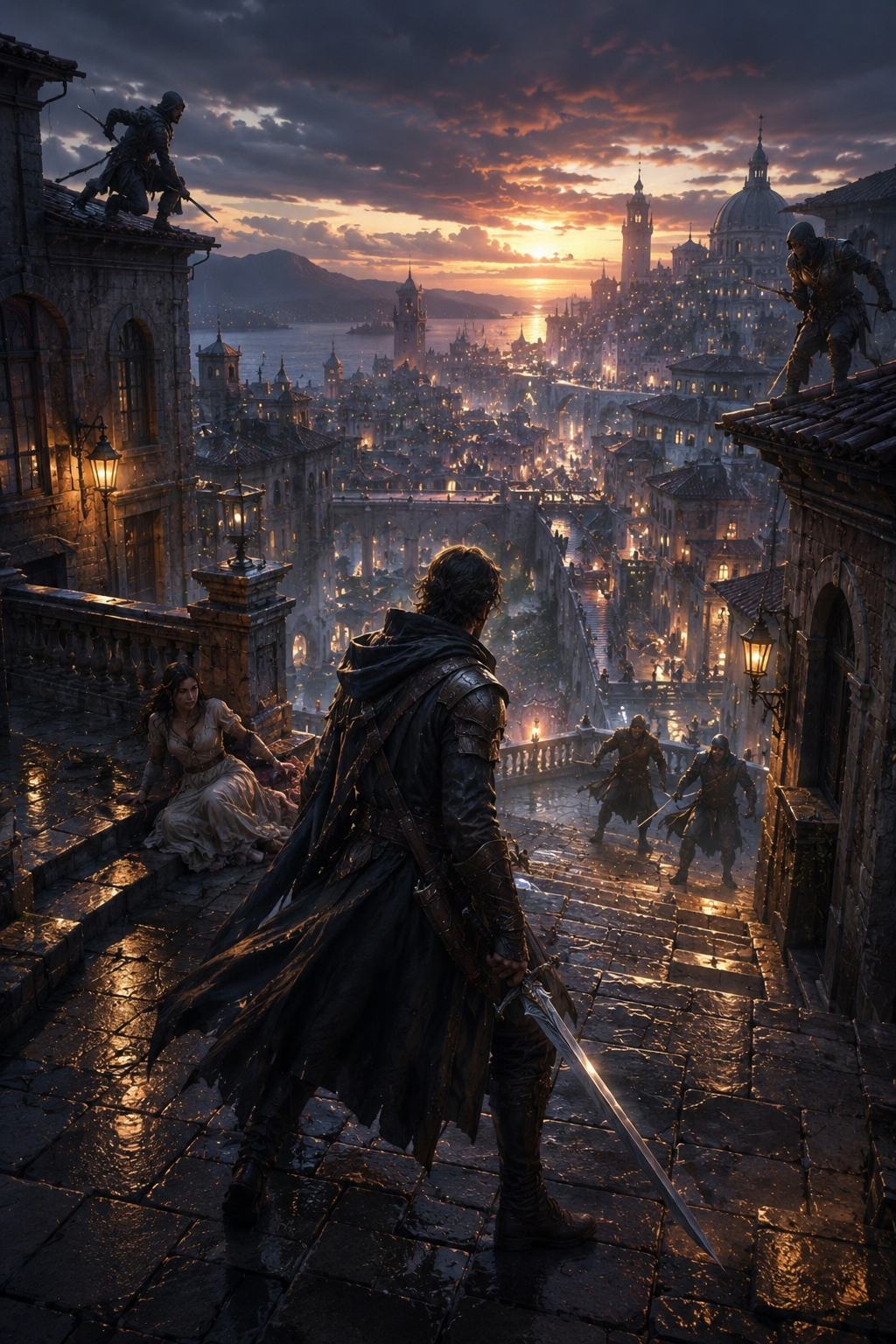
Combat Example: Rooftop Chase in Marisalor
The scene takes place on the rain-slicked rooftops of Marisalor’s Mid-Tier during a nighttime pursuit. Kael (14 AP) and Sira (10 AP) are chasing a courier carrying sensitive documents for a rival faction.
The GM describes three zones: the Narrow rooftop they start on (Difficult Terrain from rain and loose tiles), an adjacent Elevated walkway connecting to the next building, and a lower Open Courtyard below, in case someone falls or jumps.
Kael opens aggressively. He spends 5 AP to sprint across the Narrow rooftop and make a powerful leaping attack on the courier. He succeeds, slamming into the courier and driving him toward the edge. However, this heavy investment leaves him with only 9 AP remaining.
The courier counters, forcing Sira to react. She spends 2 AP to move into the Elevated walkway zone and fire a crossbow from a better angle. Her shot hits, but not decisively. The courier, now desperate, kicks loose tiles toward her (creating more Difficult Terrain in her zone).
Mid-scene, the tension peaks. Kael has 9 AP left, Sira has 7. The courier is wounded but still moving. Kael must decide: commit another 4 AP to try ending the chase here, or play more conservatively? He chooses the bold route, spending 4 AP on a final charge. He succeeds spectacularly, tackling the courier and securing the documents.
The scene ends with the characters victorious but exhausted , Kael has only 5 AP left, Sira has 6. If another threat appears before the next scene, they will be at a real disadvantage. The heavy early spending gave them control, but it came at a cost they can feel.
Social Example: Bargaining in the Grand Bazaar
The characters need critical information from a well-connected spice merchant in Marisalor’s bustling Grand Bazaar. The scene begins in the merchant’s crowded stall (Narrow zone filled with hanging sacks and barrels , Concealed but Cramped).
The diplomat opens with a reasonable offer, spending 2 AP. The total is close but insufficient. The merchant smiles politely but remains unmoved. “Information like that is expensive, my friend. And dangerous.”
The failure shifts the scene. The merchant grows more cautious and begins testing their intentions. Social opposition increases.
The group’s second character steps forward, revealing a piece of valuable gossip as leverage while committing 3 AP. This higher investment meets the new DC. The merchant leans in, interested , but now wants something in return: the characters must agree to deliver a sealed message to a contact in the Waterfront Tier without opening it.
The scene ends with the characters gaining the information they needed, but they now carry a suspicious package and a new obligation that could draw them into larger conflicts.
In both scenes, every major turning point was shaped by deliberate decisions about how many Action Points to spend an to spend themed when. There were no random rolls deciding success or failure. The outcomes, and their costs, came directly from the players’ choices.
Common Player Questions & Edge Cases
As players get deeper into Legends of Thaloranth, a few questions tend to come up repeatedly. Here are the most important ones, answered clearly.
“What happens if I run out of Action Points mid-scene?”
You can still act normally , you simply cannot spend additional AP to boost checks, movement, or defenses. This creates a very tangible feeling of exhaustion. Many players describe it as “I’ve given everything I have, now I’m fighting on pure skill.” It’s rarely fatal, but it makes the end of a tough scene feel desperate and dramatic.
“Can I save Action Points for the next scene?”
No. Any unspent Action Points are lost when the scene ends. This rule is deliberate , it prevents hoarding and forces players to use their resources meaningfully within each scene.
“How does spending AP interact with critical successes or exceptional results?”
Overspending (going well above the required DC) often grants additional benefits, such as extra damage, better positioning, or stronger narrative outcomes. The GM is encouraged to reward bold investment with satisfying payoffs.
“What about Luck Points?”
Luck Points are a separate, rarer resource that can be used to reroll or adjust results in extreme situations. They serve as a safety valve without undermining the core Action Point economy.
“How do I handle very long or complex scenes?”
The GM has discretion to split a very long sequence into multiple scenes if the situation meaningfully changes (for example, moving from a street fight to a chase to a hideout negotiation). This keeps the resource pressure appropriate to the drama.
New players sometimes worry that the system will feel restrictive. In practice, most discover the opposite: once they get comfortable spending Action Points boldly at the right moments, the game feels incredibly freeing. The limitations create focus. The decisions create drama.
Why Action Points Make the Game Better
Action Points are the reason Legends of Thaloranth feels fundamentally different from most other RPGs , and why so many players who try the system never want to go back to dice-heavy play.
They create consistent tension without relying on randomness. Every scene has a natural dramatic arc because resources are limited and only reset when the story moves forward. Players feel the weight of their choices in real time.
They promote a deeper strategy. Instead of hoping for good rolls, players learn to read scenes, prioritize threats, manage resources, and coordinate with their group. The system rewards cleverness, timing, and adaptability far more than raw luck.
They deliver stronger narrative ownership. When you succeed, it’s because you chose the right moment to commit. When you fail or succeed at a cost, it’s because of a decision you made , not because a die betrayed you. This creates stories that feel personally earned.
They support multiple play styles elegantly. Solo players get a clear structure and satisfying resource management. Groups get rich tactical interplay. Hybrid campaigns flow naturally because the core engine stays consistent.
Most importantly, Action Points make every scene feel alive. The environment (through zones), the opposition, and your own limited resources all interact in meaningful ways. The game stops feeling like a series of isolated rolls and starts feeling like a continuous, dramatic experience where your decisions shape everything.
This is why the system was built this way. Action Points aren’t just a replacement for dice , they are a superior foundation for dramatic, player-driven roleplaying.
Conclusion: The Heart of Legends of Thaloranth
Action Points are the soul of Legends of Thaloranth.
They turn abstract philosophy into concrete, moment-to-moment gameplay. They replace the randomness of dice with the drama of meaningful choice. They create tension through limitation and reward through smart investment.
If you want a game where your decisions consistently matter, where resource management feels visceral, and where every scene has real dramatic weight, Action Points delivers.
They are the reason players describe Legends of Thaloranth as “the game where I finally feel in control of my character’s fate.”
Ready to experience it for yourself?
If you are new to the system, you may want to start with “What Is Legends of Thaloranth?”, which introduces the core ideas behind the game, or “Why Diceless Tabletop RPGs Work (And Why Most People Are Wrong About Them)”, where we explore the philosophy behind player-driven outcomes and meaningful choice.
Start with the Player’s Guide and Basics Rule Book, both available now on Gumroad. Then explore the growing world of Vaeloraranth through the Gazetteers, setting books, and campaigns.
Your Action Points are waiting.
The only question left is: how will you spend them?
Become a member of our Review Guild HERE.
Curious about the philosophy behind Legends of Thaloranth? Read the recent Q&A discussing the system’s design, solo play, and diceless approach.
Leave a Reply