Character Creation in 15 Minutes in Legends of Thaloranth
One of the first things every player experiences in a new roleplaying game is character creation. Before the first adventure begins, before the first challenge appears, and before the first scene unfolds, players are asked a simple question:
Who are you going to be?
The answer to that question shapes everything that follows.
It influences the decisions a character makes, the challenges they are drawn toward, the relationships they build, and the role they eventually occupy within the story. Long before the first Action Point is spent or the first skill check is attempted, character creation is already helping define the kind of adventure a player will experience.
This is one of the reasons character creation occupies such an important place within Legends of Thaloranth. The system is built around meaningful choices, meaningful consequences, and meaningful stories. If you’ve already read What a Scene Looks Like in Legends of Thaloranth, you’ve seen how that philosophy influences play at the table. Character creation follows the same philosophy by focusing on people first and mechanics second.
That does not mean mechanics are unimportant. Stats, skills, Paths, equipment, and obligations all play important roles within the game. What makes character creation in Legends of Thaloranth different is the way those elements work together to create a person rather than simply a collection of numbers.
The result is a process that is both surprisingly fast and surprisingly flexible. Most characters can be created in about fifteen minutes, yet those same characters possess enough depth to support years of adventures, discoveries, victories, failures, friendships, rivalries, and personal growth.
In this article, we’ll examine how character creation works, why the process is structured the way it is, and how a handful of simple decisions become the foundation for an entire campaign.
Why Origins Come First in Character Creation
Once a player has a concept in mind, the first major decision in character creation is choosing an Origin.
At first glance, this may seem like an unusual place to begin. Many roleplaying games place considerable emphasis on attributes, abilities, or other mechanical choices early in the process. Legends of Thaloranth starts somewhere different because Origins answer a question that every character must answer before anything else can be built upon it.
What are you?
The answer does not determine a character’s future. It does not dictate their profession, their goals, or the path their life will eventually take. A Human and a Sylvani can pursue the same dream. A Forgeborn and a Meadowkin can stand side by side in the same adventure. A Tinkersprite and a Human can become lifelong friends, trusted allies, or bitter rivals.
Yet none of them begin from exactly the same place.
Origins establish the foundation upon which the rest of the character is built. They provide culture, perspective, history, and a connection to the world long before skills, Paths, and equipment enter the picture, they help answer where a character comes from and how they fit into the larger tapestry of Vaeloraranth.
This foundation influences many of the choices that follow. The way a character approaches a challenge, the traditions they value, the communities they identify with, and even the opportunities available to them can all be shaped by their Origin. These influences do not restrict the character. If anything, they help make later choices more meaningful because those choices are being made by someone rather than something.
This distinction is important.
A character is not defined solely by an Origin any more than they are defined solely by a skill, a Path, or a piece of equipment. Character creation in Legends of Thaloranth is built upon layers. Origins form the first of those layers, providing a starting point from which the rest of the character can grow.
Before deciding what a character has learned, it helps to understand where they began. Before deciding who they are becoming, it helps to understand who they are.
That is why Origins come first.
Stats Describe Potential
Once a character’s Origin has been established, the next step is assigning their core stats. This is often the point where players begin thinking about what their character can actually do.
That question is important, but it can also be misleading.
Stats do not tell us everything a character is capable of accomplishing. They tell us where that character’s natural strengths and weaknesses lie before training, experience, and personal choices begin shaping the rest of their story.
Legends of Thaloranth uses four core stats: Power, Agility, Insight, and Social. Together, these stats form the foundation upon which the rest of the character is built. They influence a wide variety of actions, challenges, and decisions throughout play, but they do not define the character by themselves.
This distinction is important because stats and skills represent two very different things.
A character with high Agility may possess excellent natural coordination, quick reflexes, and impressive physical control. That does not automatically make them a skilled swordsman. A character with strong Insight may be naturally perceptive and intelligent, but that does not mean they have spent years studying history, magic, or medicine.
Natural talent and learned ability are not the same thing.
Most people encounter this distinction in everyday life. Some individuals seem naturally athletic. Others possess remarkable social awareness. Some grasp new ideas quickly, while others demonstrate exceptional determination and physical strength. Those natural traits create opportunities, but they do not replace practice, training, and experience.
Character creation in Legends of Thaloranth approaches stats in much the same way. Stats establish potential. They help define what comes naturally to a character. Skills, on the other hand, reveal what that character has actually spent time learning.
That difference becomes increasingly important as the character begins to take shape. Origins established where the character began. Stats help establish what comes naturally to them.
The next layer answers a different question entirely.
What have they learned?
Skills Tell a Story
If Origins establish where a character began and stats describe their natural potential, skills tell us what happened next.
No one enters the world knowing how to fight with a sword, track a fugitive through the wilderness, negotiate a trade agreement, or diagnose an illness. Those abilities are learned through experience, training, study, failure, and repetition. Skills represent the knowledge and expertise a character acquires throughout their life.
This is one of the reasons skills reveal so much about a character.
A list of skills is more than a collection of mechanical bonuses. It is a record of where a character has invested their time and effort. Two characters may possess similar stats and share the same Origin, yet look completely different once their skills are examined. The differences begin to tell a story.
A character trained in Survival, Tracking, and Wilderness Lore has likely spent considerable time beyond the safety of city walls. A character focused on Diplomacy, Etiquette, and Negotiation suggests a very different life. Neither approach is better than the other. They simply reflect different experiences, different priorities, and different personal histories.
This idea sits at the heart of the skill system in Legends of Thaloranth. Skills are not merely tools for resolving challenges. They are one of the clearest expressions of who a character is and how they arrived at this point in their life.
The relationship between stats and skills is also worth noting. Stats provide the foundation, but skills refine and direct that potential. Natural talent may create opportunities, but training determines how that talent is applied. A character may possess exceptional Agility, but without the appropriate skills they may never become an accomplished archer, scout, or duelist.
By the time skills have been selected, the character is beginning to feel less like an idea and more like a person. Origins established where they began. Stats revealed their natural strengths. Skills now show what they have chosen to do with those strengths.
The next step looks beyond the past and asks a different question.
Who are they becoming?
Paths Show Who You Are Becoming
Up to this point, character creation has focused primarily on the past.
Origins help establish where a character began. Stats describe their natural strengths and weaknesses. Skills reveal what they have learned through experience, training, and practice. Each of these elements helps explain how the character arrived at the moment where the story begins.
Paths ask a different question.
Who are they becoming?
This distinction is one of the defining characteristics of character creation in Legends of Thaloranth. Many roleplaying games use classes to determine a character’s role within the party and the abilities they will gain as they advance. Classes can certainly be effective, but they often encourage players to think about their characters in terms of fixed roles and predefined progressions.
Paths approach character growth from a different direction.
Rather than defining what a character is, a Path helps define the direction their life is taking. A skilled warrior and a veteran scout may begin with similar experiences, yet choose very different Paths as their stories unfold. Likewise, two characters following the same Path may arrive there through entirely different journeys. The Path provides direction, but it does not dictate every step along the way.
This flexibility is one of the reasons Paths occupy such an important place within the system. Characters are not expected to remain static. They gain new experiences, develop new interests, build relationships, face challenges, and discover opportunities they never anticipated when the campaign began. Paths provide a framework for that growth while still allowing the character to remain an individual.
Readers interested in exploring this philosophy in greater detail may want to read Paths Instead of Classes, which examines the design decisions behind the Path system and the role it plays within long-term character development.
By the time a player selects a Path, the character is beginning to take shape. Origins established where they came from. Stats revealed their natural potential. Skills showed what they have learned. Paths now provide a sense of direction, helping answer not only who the character is today, but who they may become tomorrow.
The next question is far more practical.
What are they bringing with them when the adventure begins?
Why Equipment Kits Exist
Few parts of character creation have generated more debate over the years than equipment.
For some players, selecting gear is an enjoyable part of the process. They enjoy comparing options, weighing tradeoffs, and carefully assembling the tools they believe their characters will need. For others, equipment quickly becomes a shopping exercise that slows down the process of getting a character into play.
Most experienced roleplayers have experienced both approaches.
They have spent time studying equipment lists, comparing nearly identical items, calculating costs, and debating purchases that may never matter once the campaign actually begins. While there is certainly nothing wrong with detailed equipment systems, they often shift attention away from the character and toward inventory management.
Legends of Thaloranth approaches the problem differently through the use of equipment kits.
The purpose of a kit is not to remove meaningful choices. The purpose is to focus those choices on the character rather than the shopping list.
Instead of selecting every item individually, players can choose equipment packages designed around common professions, lifestyles, and adventuring roles. A wilderness traveler begins with different tools than a scholar. A merchant carries different supplies than a wandering healer. The equipment reflects the character without requiring players to spend large amounts of time purchasing every item separately.
This approach also supports one of the central goals of character creation in Legends of Thaloranth: maintaining momentum. By this stage, a player has already established an Origin, assigned stats, selected skills, and chosen a Path. The character is beginning to feel like a real person. Equipment should reinforce that identity rather than interrupt it.
In many ways, equipment kits are simply another tool for telling the character’s story. The choices still matter. They simply occur at a level that emphasizes who the character is instead of how long they spent shopping before the adventure began.
The purpose of equipment is not to delay the beginning of the story. Its purpose is to help the story begin.
Obligations Connect Characters to the World
People do not live in isolation.
Every person belongs to something larger than themselves. Family, friends, communities, professions, organizations, promises, responsibilities, and relationships all shape the choices people make throughout their lives. Even those who spend years trying to leave their past behind often discover that the past has a way of following them.
Characters are no different.
A common feature of fantasy roleplaying is the wandering adventurer with no ties, no responsibilities, and no meaningful connections to the world around them. While there is certainly nothing wrong with that approach, it often creates a strange situation. The character may possess impressive abilities and a detailed backstory, yet have very little reason to care about anything happening around them.
Legends of Thaloranth approaches the problem differently through Obligations.
An Obligation is not simply a mechanical feature added to a character sheet. It is a reminder that every character exists within a larger world. A promise made years ago. A debt that remains unpaid. A responsibility that cannot be ignored. A friendship worth protecting. A community that depends upon them. These connections create roots that anchor a character within the setting.
This changes the nature of storytelling in subtle but important ways.
When trouble threatens a distant village, a character may choose to help because it is the heroic thing to do. When trouble threatens a village where their family lives, the situation feels very different. The challenge may be the same, but the emotional investment is not. The story matters because the people involved matter.
This philosophy appears throughout Legends of Thaloranth. Readers who have explored Solo Play in Legends of Thaloranth or Cozy Play in Legends of Thaloranth have already seen how relationships often become the foundation upon which entire stories are built. Obligations bring that same philosophy into character creation, ensuring that characters begin play as part of the world rather than standing apart from it.
By the time a player reaches this stage of character creation, they have established an Origin, assigned stats, selected skills, chosen a Path, and gathered equipment. They know what the character can do, they know where the character came from, they know what the character hopes to become.
Obligations answer a different question.
Why does any of it matter?
Why Creating a Character in 15 Minutes Actually Works
At this point, some readers may be wondering how all of these pieces can come together in only fifteen minutes.
After all, character creation includes Origins, stats, skills, Paths, equipment, and obligations. On paper, that sounds like a substantial amount of information to process before play begins.
The answer lies in how those decisions are structured.
Many character creation systems ask players to make dozens of choices in rapid succession. Some of those choices are meaningful. Others exist primarily because they have always been part of character creation. Players often spend considerable time comparing options, reviewing lists, and attempting to optimize decisions before they fully understand the character they are creating.
Legends of Thaloranth approaches the process differently.
Each decision builds upon the one that came before it.
The concept helps inform the Origin. The Origin provides context for the stats. Stats support skill selection. Skills help guide Path choices. Equipment reinforces the character’s identity. Obligations connect that character to the world around them.
Rather than forcing players to solve every problem at once, character creation unfolds as a series of related decisions. Each choice narrows the focus of the next, making the overall process easier rather than more complicated.
This structure also helps eliminate a common source of frustration during character creation: uncertainty. Players rarely need to ask what skill makes the most sense, what equipment they should purchase, or which Path they should follow if they already have a clear understanding of the character they are building. The earlier decisions provide direction for the later ones.
The result is a process that remains fast without feeling rushed.
Character creation in Legends of Thaloranth is not designed to produce disposable characters. The goal is not speed for its own sake. The goal is to remove unnecessary obstacles between the player and the story.
Fifteen minutes is simply the result of a process built around clarity, focus, and meaningful choices.
Building a Character
Let’s put everything together.
For this example, we’ll create Talia Riversong.
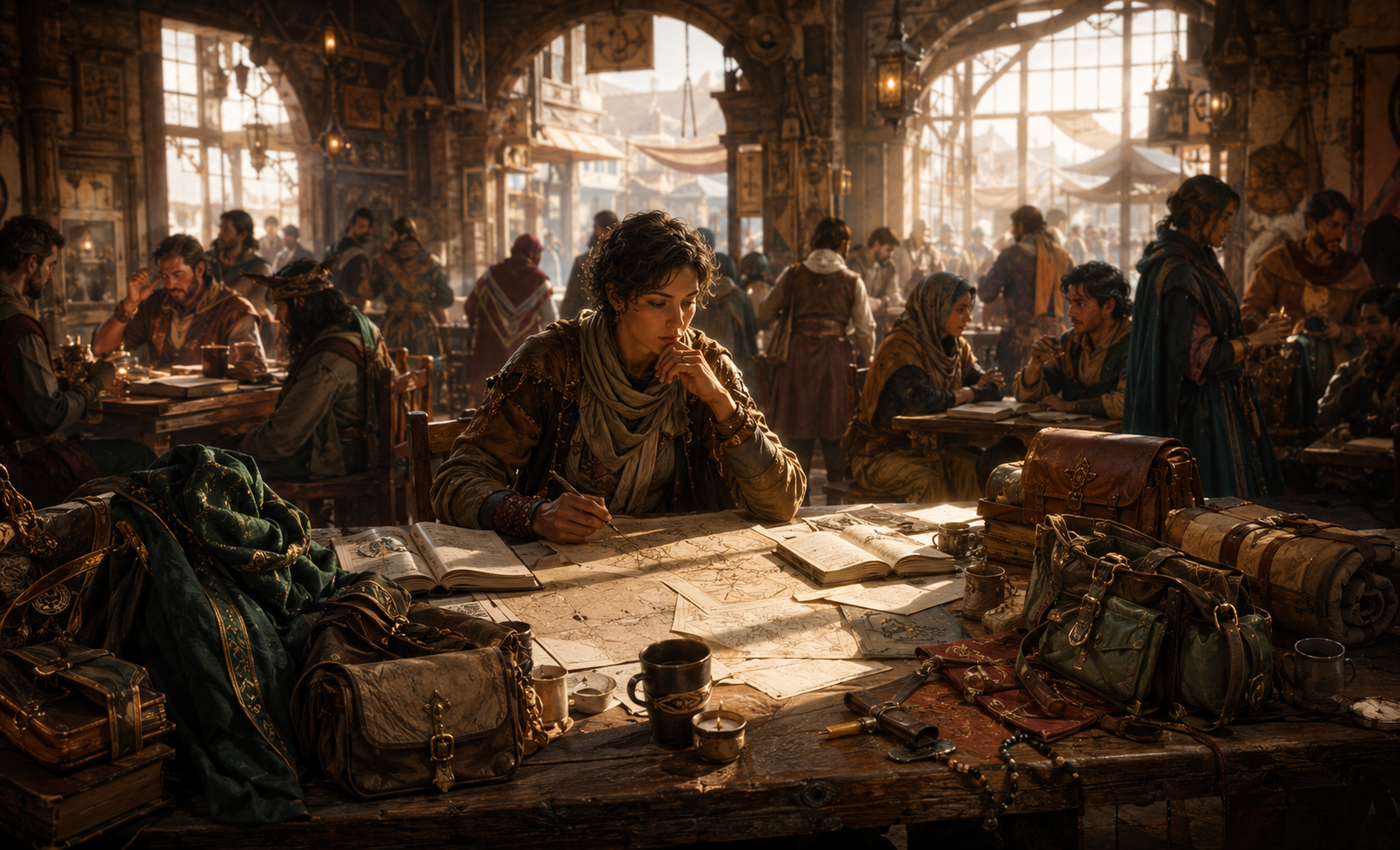
The concept is simple: Talia is a former caravan guard who now escorts merchants between Radia and Marisalor.
That single sentence already gives us a direction for the rest of character creation.
Talia’s Origin is Human. She was born and raised in Sovereign’s Reach and spent most of her life traveling the trade roads that connect the Heartlands.
Her stats reflect the life she has lived. Agility and Insight matter more to her than raw physical power. Years spent watching the road for danger have taught her that awareness often solves problems before a sword ever leaves its scabbard.
Her skills continue building upon that idea. Survival, Tracking, Persuasion, and Swordsmanship all reflect experiences gained during years of caravan work. None of these choices exist in isolation. Each one reinforces the original concept.
For her Path, Talia chooses Skirmisher. The Path complements the mobility, adaptability, and practical problem-solving skills she developed while traveling between cities and settlements.
Her equipment follows naturally from those earlier decisions. An Adventurer’s Kit provides the tools she needs to spend long periods on the road without forcing the player to spend time shopping through pages of individual items.
Finally, Talia takes an Obligation. Several years ago, a merchant family in Radia helped her recover after a disastrous caravan raid. She still owes them a favor, and one day they may decide to collect.
At this point, Talia is ready to play.
More importantly, she feels like a person rather than a collection of numbers on a sheet. Her skills make sense because they reflect the life she has lived. Her Path feels natural because it grows from that experience. Even her Obligation reinforces the larger story by connecting her to people and events beyond herself. Each decision supports the others, creating a character who feels grounded in the world rather than assembled from unrelated parts.
And all of it began with a simple idea: a former caravan guard traveling the roads between Radia and Marisalor.
Why Creating a Character in 15 Minutes Actually Works
After reading through the process, some players may wonder how a character like Talia can come together in only fifteen minutes.
The answer is not that Legends of Thaloranth removes depth from character creation. If anything, the opposite is true. Characters possess Origins, stats, skills, Paths, equipment, obligations, and plenty of room for personal history and growth. On paper, that sounds like a great deal to accomplish in a short period of time.
The difference lies in how the decisions are organized.
Many character creation systems present players with large numbers of options from the very beginning. Attributes, abilities, equipment, professions, backgrounds, and other choices often appear simultaneously. While experienced players may enjoy exploring those possibilities, newer players frequently find themselves trying to answer questions before they understand the character they are building.
Legends of Thaloranth approaches the process differently.
Each decision helps inform the next.
A concept provides direction for choosing an Origin. The Origin helps establish the character’s foundation. Stats describe natural strengths and weaknesses. Skills reflect how those strengths have been developed through experience. Paths help determine where the character is headed. Equipment supports the life they have chosen to live. Obligations connect them to the world around them.
Rather than competing with one another, the decisions work together.
Talia provides a useful example. Once the concept of a former caravan guard was established, many of the later choices became easier to understand. The Origin, skills, Path, equipment, and Obligation all grew naturally from that original idea. The process did not become faster because choices were removed. It became faster because each choice provided context for the next.
This is one of the reasons character creation in Legends of Thaloranth feels focused rather than rushed. The system is designed to help players move from concept to character without becoming lost in unnecessary complexity.
The goal is not to finish quickly, it is to arrive at a character who feels ready for the story ahead.
Fifteen minutes is simply the result.
Final Thoughts
Fifteen minutes may not sound like much time.
In many roleplaying games, fifteen minutes is barely enough time to finish assigning stats, compare equipment lists, or decide between a handful of character options. Character creation can easily become a process of managing information rather than imagining a person.
Legends of Thaloranth approaches the process from a different direction.
By the end of character creation, the goal is not simply to have a completed character sheet. The goal is to have a character who feels ready to step into the story. Someone with a place in the world, skills shaped by experience, a direction for future growth, and connections that make the events of the campaign matter.
That is why the process begins with a concept and builds outward from there. Each decision supports the next. Origins provide a foundation. Stats establish potential. Skills reveal experience. Paths create direction. Equipment supports the life the character has chosen to live. Obligations connect that character to the people, places, and responsibilities that give stories meaning.
The result is a process that remains fast without becoming shallow.
At the end of those fifteen minutes, players have more than a collection of numbers, abilities, and equipment. They have someone capable of making choices, facing challenges, building relationships, and leaving a mark upon the world around them.
More importantly, they have someone worth following into the stories ahead.
Because that has always been the real purpose of character creation in Legends of Thaloranth.
Not to complete a character sheet, but to create the person whose story is about to begin.
Continue Your Journey
Creating a character is only the first step.
Whether you want to explore ancient ruins, build a merchant empire, compete in legendary tournaments, sail dangerous seas, or simply build a quiet life in one of Vaeloraranth’s great cities, there is a place for your story in Legends of Thaloranth.
Continue with the Core Line
The Player’s Guide and Game Master’s Guide provide the complete Legends of Thaloranth experience, expanding character options, Paths, organizations, social systems, magic, exploration, and campaign play.
Explore the World
Journey beyond your starting character through the growing World Series, including guides to the Heartlands, Vaeloraranth, major cities, cultures, trade routes, and the history that shapes the world around you.
Discover New Creatures
The Menagerie Series introduces the animals, monsters, vermin, and supernatural beings that inhabit Vaeloraranth, bringing the world to life with allies, adversaries, and unforgettable encounters.
Experience Solo Adventures
Prefer to play alone? The Solo Line provides oracles, generators, campaigns, and character-driven adventures that allow you to explore Vaeloraranth without a Game Master or group.
Discover Everyday Life
The Cozy Line, beginning with Hearth and Home: Radia, focuses on friendships, community, occupations, festivals, and the small moments that transform a city into a home.
For those who prefer printed books, visit our Lulu store.
No matter where your story begins, in the marketplaces of Radia, the courts of kings, the wilderness beyond civilization, or the quiet comfort of a neighborhood tavern, the world of Vaeloraranth is waiting.
Your legend starts here.
Leave a Reply
You must be logged in to post a comment.