What a Scene Looks Like in Legends of Thaloranth
If you’ve spent any time reading the articles on this site, you’ve probably noticed that the word scene appears frequently. That isn’t an accident. Understanding what a scene looks like in Legends of Thaloranth is one of the fastest ways to understand how the entire game functions.
Many tabletop roleplaying games organize play around encounters, rounds, turns, and individual actions. Those tools certainly have value, and they have served the hobby well for decades. Legends of Thaloranth does not discard those ideas entirely, but it approaches them from a different direction. Rather than treating individual actions as the primary unit of play, the game focuses on scenes: complete dramatic situations that present meaningful choices, meaningful consequences, and opportunities for characters to influence the world around them.
This distinction may sound subtle at first, but it has a profound effect on how the game feels at the table. A scene is more than a combat encounter. It is more than a skill check. It is more than a conversation with a non-player character. A scene is the framework that gives those individual moments meaning by connecting them to a larger purpose within the story.
That philosophy appears throughout the system. It influences how Action Points are spent, how challenges are resolved, how experience is earned, and even how adventures are structured. The same scene-based approach that drives a tense negotiation in a noble court also drives a desperate battle against a Trogmar warband, an investigation within the streets of Radia, or a solo adventure using the Legends of Thaloranth Solo Rules.
In this article, we’ll examine what a scene looks like in Legends of Thaloranth, why scenes serve as the foundation of play, and how the concept shapes the decisions players make throughout an adventure. We’ll also look at a scene taken directly from play and explore how goals, obstacles, consequences, and player choices come together to create the kind of stories the system was designed to support.
What Is a Scene in Legends of Thaloranth?
The Player’s Guide defines a scene as the fundamental unit of play in Legends of Thaloranth. Every scene has a beginning, a development, and a conclusion. Action Points recover at the end of a scene because scenes, rather than rounds or encounters, serve as the primary measure of progress within the game.
That definition is simple enough on the surface, but it becomes much more meaningful when we look at what the Game Master’s Guide adds to the discussion. A scene is not merely a collection of actions that happen to occur in the same location. It is a complete dramatic unit that changes something about the situation when it ends.
That final idea is the important one.
A scene should matter.
When a scene closes, something should be different than it was when the scene began. The characters may possess new information. They may have gained an ally, made an enemy, uncovered a clue, solved a problem, or created a new one. The specific outcome matters less than the fact that the situation has changed.
This is one of the reasons scenes sit at the center of Legends of Thaloranth’s design philosophy. The game is not primarily concerned with simulating every moment of a character’s day. It is concerned with the moments that matter. A merchant crossing a city square is not automatically a scene. Convincing that merchant to reveal information that could expose a conspiracy might be.
The distinction is important because it helps answer a question that many Game Masters struggle with regardless of system:
When is something worth playing out?
In Legends of Thaloranth, the answer is usually straightforward. If the situation presents meaningful choices, meaningful consequences, and the possibility of changing the direction of the story, it is probably a scene. If it does not, it is often better handled through narration and transition.
This does not mean every scene must be dramatic in the traditional sense. Some scenes involve danger. Others involve discovery. Some revolve around social interaction, investigation, travel, negotiation, or simple decision-making. What they share is purpose. Every scene exists to accomplish something within the larger story.
Understanding that purpose is the first step toward understanding how play flows in Legends of Thaloranth.
To understand what a scene looks like in Legends of Thaloranth, it is helpful to begin with the role scenes play within the larger structure of the game.
Every Scene Should Change Something
One of the easiest traps a Game Master can fall into is confusing activity with progress.
Characters travel from one location to another. They speak with non-player characters. They search rooms, investigate rumors, browse markets, and discuss plans around campfires. None of these activities are inherently bad. In fact, many of them are necessary. The problem arises when activity becomes disconnected from purpose.
A scene that changes nothing is difficult to remember because, in practical terms, it did not matter. The characters entered the scene in one state and left it in exactly the same state. They learned nothing important. They made no meaningful decision. No new opportunities appeared. No new complications emerged. The world remained exactly as it was before the scene began.
Most roleplaying games contain moments like this. Every Game Master has run them. Every player has experienced them. They are rarely disastrous, but they often consume time without adding much to the story. The players remain busy, yet the adventure itself does not move forward.
Legends of Thaloranth approaches scenes from a different perspective.
The Game Master’s Guide describes a scene as a complete dramatic unit that changes something about the situation when it closes. That change does not have to be dramatic. The characters may discover a clue, gain an ally, lose a resource, reveal information, make a promise, attract unwanted attention, or simply learn that their original assumptions were wrong. The specific outcome is less important than the fact that the situation is no longer the same as it was before.
Change Creates Momentum
This idea influences every part of the system.
The resolution framework asks Game Masters to call for checks only when the outcome is uncertain, failure carries meaningful consequences, and the result will change something about the scene. That guidance is not merely advice about mechanics. It reflects a larger design philosophy. The game consistently focuses attention on moments where decisions matter and where outcomes have the potential to reshape the situation.
Once viewed through that lens, scenes begin to look different. A locked door is not automatically a scene. A difficult negotiation is not automatically a scene. Even a combat encounter is not automatically a scene. Those things become scenes when they are connected to a meaningful question whose answer will change the direction of events.
That distinction may seem small at first, but it has profound consequences for pacing. When scenes are built around meaningful change, the story naturally moves forward. Information accumulates. Relationships evolve. Problems become more complicated or move closer to resolution. Characters begin making decisions that matter because the game consistently places them in situations where their choices produce consequences.
One of the defining characteristics of what a scene looks like in Legends of Thaloranth is that the situation changes in some meaningful way before the scene concludes.
A scene, therefore, is not defined by what the characters are doing.
It is defined by what changes because they did it.
Why Activity Alone Is Not Enough
Activity Versus Progress
One of the reasons scene-based play can be difficult to understand at first is that most roleplaying games contain a tremendous amount of activity.
When examining what a scene looks like in Legends of Thaloranth, it quickly becomes apparent that activity alone is not enough to sustain a meaningful scene.
Characters travel from place to place. They gather information. They purchase equipment. They discuss plans, investigate rumors, scout locations, question witnesses, and prepare for whatever challenge lies ahead. Entire sessions can be filled with activity, and on the surface those sessions may feel productive because the players are constantly doing something.
The problem is that activity and progress are not the same thing.
A character can spend an entire evening chasing leads that never develop, speaking with people who have nothing useful to contribute, or moving from one location to another without anything meaningful changing. The players remain active throughout the session, yet the story itself remains largely where it began.
This distinction is important because activity is easy to create.
Purpose is harder.
Giving players things to do requires very little effort. Giving them something that matters requires considerably more thought. The first asks only what the characters are doing. The second asks why they are doing it, what stands in their way, and what might happen if they fail.
Stories are rarely remembered because of activity alone.
People remember moments because those moments carried weight. A difficult decision, a painful sacrifice, an unexpected revelation, a hard-earned victory, or even a devastating failure remains memorable because it changes the direction of events. The story becomes different because of what happened.
That principle sits quietly beneath the structure of Legends of Thaloranth.
The game is not particularly interested in keeping characters busy. It is interested in presenting situations that matter. The purpose of a scene is not to occupy time between important events. The purpose of a scene is to be an important event.
Once that distinction becomes clear, scenes begin to look very different. The question is no longer whether the characters are doing something.
The question becomes whether what they are doing has the potential to change the story.
Every Scene Begins With a Question
Questions Create Direction
If scenes are defined by meaningful change rather than simple activity, the next question becomes obvious: how do we recognize a scene when we see one?
At the heart of what a scene looks like in Legends of Thaloranth is a question that remains unanswered.
The answer is surprisingly simple.
Every meaningful scene begins with a question.
Not a question that appears on a character sheet or a question asked by the Game Master, but a question that exists within the story itself. The characters want something. Something stands in their way. The outcome is uncertain. Until that uncertainty is resolved, the scene continues.
This idea appears so naturally in storytelling that most people rarely stop to think about it. Yet it sits beneath nearly every memorable moment in fiction. Will the detective uncover the truth? Will the hero arrive in time? Will the kingdom survive the invasion? Will the lovers reconcile before it is too late?
The audience continues reading because the question remains unanswered.
Roleplaying games function in much the same way.
A scene begins when a meaningful question enters the story. The characters may not even recognize the question immediately. They simply encounter a situation that demands attention. As they engage with that situation, the underlying question gradually reveals itself.
Sometimes the question is obvious. Can the characters stop the bandits before they escape? Can they convince the magistrate to hear their case? Can they survive the attack?
Sometimes the question is more subtle. Can they discover who is lying? Can they determine which ally can be trusted? Can they uncover the truth before acting on incomplete information?
Regardless of its form, the question serves an important purpose. It creates direction. It gives the players something to pursue and provides the Game Master with a framework for determining when the scene has reached its conclusion.
This is one of the reasons scenes in Legends of Thaloranth rarely feel disconnected from the larger story. The scene is not merely a collection of actions taking place in the same location. It exists because a meaningful question has entered the narrative and the characters have chosen to engage with it.
The scene continues as long as that question remains unanswered.
Once the answer becomes clear, the scene has reached its natural conclusion and the story moves forward.
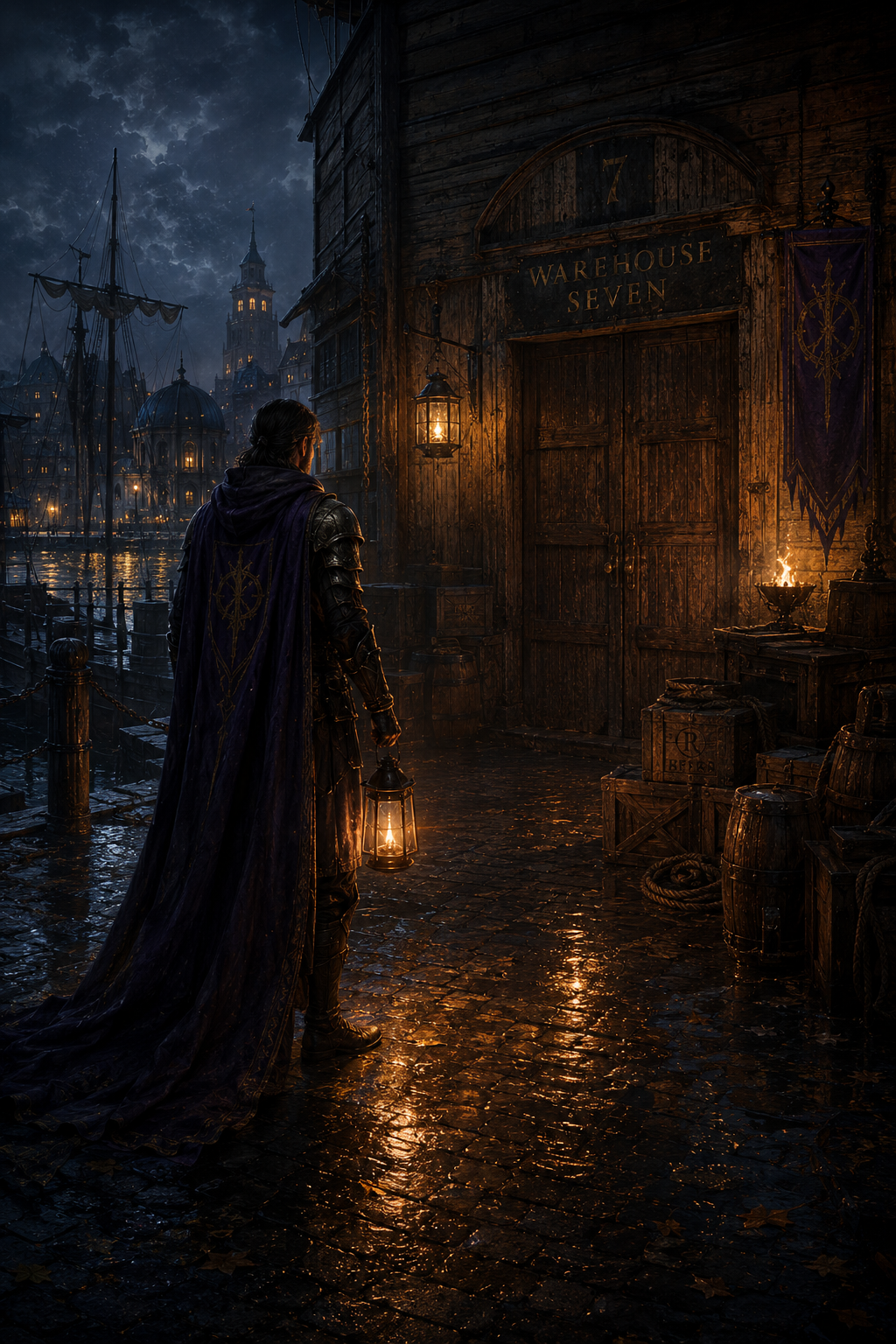
At first glance, it would be easy to assume that Warehouse Seven is the scene. After all, it is the location where the player arrives, the place where the investigation begins, and the setting in which the next series of events will unfold. Many roleplaying games naturally train players to think this way. A new location appears, the characters interact with it, and eventually they move on to the next location.
Yet the warehouse itself is not what makes this situation interesting.
If the missing ledger had been hidden in a merchant’s townhouse, aboard a river barge, or somewhere beneath the streets of Radia, the fundamental problem facing the player would remain largely unchanged. The location might alter the details of the investigation, but it would not alter the reason the player is there in the first place.
The same principle applies to every obstacle that may appear during the investigation. The lock on the door matters because it stands between the player and the information they seek. The clues hidden within the warehouse matter because they may reveal what happened to Caldren Moth. Even the checks made during the scene derive their importance from the larger situation surrounding them. None of these elements are meaningful in isolation. They become meaningful because they help answer a question that has entered the story.
That question is what transforms a simple location into a scene.
The player is not exploring Warehouse Seven because the warehouse itself is important. The player is exploring Warehouse Seven because it may contain answers. Something happened to Caldren Moth. The ledger vanished with him. Someone may be trying to conceal the truth. Until the player uncovers what happened, uncertainty hangs over the entire situation.
That uncertainty is the heart of the scene.
Everything the player does from this point forward—searching for clues, questioning witnesses, examining evidence, or pursuing new leads—exists because of the same underlying question:
What happened to Caldren Moth, and can the missing ledger be recovered before the trail goes cold?
Once that question is answered, the scene has accomplished its purpose. Until then, the investigation continues.
The Question Gives Direction
One of the most useful aspects of viewing scenes through the lens of questions is that it immediately provides direction for both the player and the Game Master.
Without a clear question, it is surprisingly easy for a scene to lose focus. Players may spend time exploring possibilities, discussing theories, or pursuing leads that ultimately go nowhere. While some degree of uncertainty is both natural and desirable, too much uncertainty can leave everyone at the table wondering what they should be doing next.
A meaningful question provides an anchor.
This is another important aspect of what a scene looks like in Legends of Thaloranth during actual play.
In the case of Warehouse Seven, the player does not arrive with a detailed plan. They do not know what clues they will find, who may be involved, or where the investigation will eventually lead. What they do possess is a clear objective. They know there is a missing ledger. They know that Caldren Moth has disappeared. Most importantly, they know those two events are connected in some way.
That knowledge immediately narrows the focus of the scene.
Every choice can now be evaluated against the same question. Does this action help uncover what happened to Caldren Moth? Does this lead bring the player closer to the missing ledger? Does this clue reveal something important about the situation?
The player does not need to know the answer. They only need to know what they are trying to answer.
This distinction may appear subtle, but it has a significant impact on play. Many roleplaying games place a great deal of emphasis on what characters can do. Legends of Thaloranth is often more interested in why they are doing it. Once purpose becomes clear, decisions become easier to make because the player understands what they are working toward.
The same principle benefits the Game Master. A clear question provides a framework for evaluating outcomes, introducing complications, and determining when the scene has reached its conclusion. As long as the question remains unanswered, the scene continues to generate tension. Once the answer becomes clear, the story naturally moves forward to whatever comes next.
This is one of the reasons scene-based play tends to feel purposeful. The characters may not know where the story is going, but they always have a reason to take the next step.
Obstacles Create Drama
Why Resistance Matters
A question by itself is not enough to sustain a scene.
If Sera arrived at Warehouse Seven, immediately discovered the ledger, learned exactly what happened to Caldren Moth, and returned home without difficulty, there would be very little story to tell. The question would have been answered almost as soon as it was asked.
What transforms a simple question into a meaningful scene is resistance.
Something stands between the characters and the answers they seek.
Sometimes that resistance is physical. A locked door, a dangerous wilderness, a hostile opponent, or a collapsing bridge all create obstacles that must be overcome before progress can be made.
At other times, the obstacle is informational. The characters may lack critical knowledge. They may be working with incomplete evidence, unreliable witnesses, conflicting accounts, or assumptions that later prove false. In many investigations, the greatest challenge is not reaching the truth but recognizing which pieces of information can be trusted.
Social obstacles can be equally powerful. A witness may refuse to cooperate. A noble may have reasons to conceal the truth. An ally may demand something in exchange for assistance. In these situations, the challenge is not whether the characters are capable of acting, but whether they can persuade others to help them achieve their goals.
The opening scene of The Vanished Ledger contains several of these forms of resistance simultaneously. The player knows where the investigation begins, but they do not know where it will lead. They possess enough information to act, but not enough information to understand the full situation. Every clue they uncover answers one question while often creating another.
This is where much of the tension in roleplaying games originates.
Contrary to popular belief, tension is not created by danger alone. Danger is certainly one source of tension, but uncertainty is often far more powerful. A player who knows exactly what is happening and exactly how to solve the problem rarely feels much suspense. A player who possesses only part of the picture is constantly evaluating possibilities, reconsidering assumptions, and deciding which path to pursue next.
Obstacles force those decisions.
Without obstacles, there is little need for strategy, creativity, investigation, negotiation, or risk. The story moves forward automatically because nothing exists to slow its progress. Once meaningful obstacles enter the picture, however, the characters must begin making choices. Some of those choices will lead them closer to their objective. Others may create entirely new complications.
That uncertainty is not a flaw in the process.
It is the engine that drives the scene forward.
Consequences Give Choices Meaning
The Importance of Uncertainty
Questions provide direction. Obstacles create tension. Neither, however, is enough on its own. Consequences help define what a scene looks like in Legends of Thaloranth by ensuring that player decisions have lasting effects.
A scene becomes memorable when the choices made within it produce consequences.
This principle appears throughout storytelling. Readers remain invested in a story because they understand that the decisions characters make will influence what happens next. If every choice leads to the same outcome regardless of what the characters do, the story quickly begins to feel hollow. The illusion of choice may remain, but the significance of choice disappears.
Roleplaying games operate under the same principle.
Players become engaged when they believe their decisions matter. Every meaningful choice carries an element of uncertainty because the outcome has the potential to alter the situation in some way. Success may create new opportunities. Failure may introduce new complications. Sometimes a decision produces both at the same time.
This is one of the reasons Legends of Thaloranth places such a strong emphasis on consequences rather than simple pass-or-fail outcomes.
Consider the investigation at Warehouse Seven. Suppose the player discovers evidence that Caldren Moth was not acting alone. That information answers one question, but it immediately creates several more. New suspects emerge. New leads appear. The scope of the mystery expands. The scene changes because of the player’s actions.
Failure can be equally important.
Imagine that the player overlooks a critical clue or pursues the wrong lead. The story does not end. The investigation does not suddenly become impossible. Instead, the situation changes in a different direction. Time may be lost. New risks may emerge. Someone else may gain an advantage. The consequences become part of the story rather than a barrier preventing it from continuing.
This distinction is important because it changes how players approach decision-making. The goal is not simply to avoid failure at all costs. The goal is to navigate uncertainty while understanding that every choice has the potential to shape future events.
When viewed from this perspective, consequences become far more than rewards and penalties. They become the mechanism through which the story evolves. Every important decision leaves a mark on the narrative. Sometimes that mark is beneficial. Sometimes it creates new problems. Often it does both.
A scene reaches its full potential when players understand that their choices matter because those choices have consequences. Once that understanding exists, even seemingly simple decisions acquire weight. The player is no longer asking, “What can I do?”
They are asking, “What happens if I do?”
Why Failure Does Not End the Story
When Failure Creates New Problems
One of the most common challenges facing Game Masters is determining what should happen when the characters fail. One of the most distinctive elements of what a scene looks like in Legends of Thaloranth is the way failure continues the story rather than ending it.
At first, the answer appears obvious. If the characters succeed, they move closer to their objective. If they fail, they do not. The difficulty arises when the objective itself depends upon that success.
Consider an investigation. The characters are searching for information that will help them understand what happened, identify a suspect, or locate the source of a threat. Eventually they reach a point where obtaining a particular clue seems important. The clue exists. The characters look for it. Then they fail.
What happens next?
Many Game Masters eventually discover that this seemingly simple situation can create unexpected problems. If the clue is essential, the story stalls because the characters cannot proceed without information they failed to obtain. If the clue is not essential, then the failure often feels meaningless because the story continues exactly as it would have if the characters had succeeded.
Neither outcome is particularly satisfying.
The underlying issue is that many roleplaying games unintentionally treat failure as the absence of progress. The characters attempt something, they fail, and the story remains where it was before the attempt occurred. Nothing changes. The scene continues, but it continues in essentially the same state in which it began.
Legends of Thaloranth approaches the problem from a different direction.
If scenes are defined by change, then failure should create change just as surely as success does.
The characters may not receive the outcome they wanted. They may lose time, attract attention, make a poor assumption, reveal information to the wrong person, or discover that the situation is more complicated than they originally believed. Regardless of the specific result, the story should not remain frozen in place.
Returning to The Vanished Ledger, imagine that the player reaches the wrong conclusion after examining the evidence surrounding Caldren Moth’s disappearance. The investigation has not stopped. In fact, it has become more complicated. The player is now operating with incomplete or inaccurate information, and every decision made from that point forward will be influenced by that misunderstanding.
The failure becomes part of the story.
More importantly, it creates new questions.
How long will it take the player to realize the mistake? What opportunities might be missed in the meantime? Who benefits from the confusion? What new complications will emerge as a result?
Notice how different this feels from simply declaring that the investigation has failed.
The story continues moving forward. The situation changes. The consequences of the failure become part of the narrative rather than a barrier preventing the narrative from continuing.
This is one of the reasons scenes remain effective even when things go wrong. Their purpose is not to determine whether the characters are allowed to continue participating in the story. Their purpose is to reveal how the story changes in response to the choices the characters make.
Sometimes those choices lead to success.
Sometimes they lead somewhere else entirely.
In either case, the story moves forward because the scene has fulfilled its purpose: it has changed something.
Why Legends of Thaloranth Uses Scenes
From Actions to Stories
Every game designer eventually reaches a point where they must decide what their game is fundamentally about.
Some games are built around tactical combat. Others focus on resource management, exploration, survival, character optimization, or simulation. None of these approaches are inherently right or wrong. Each simply reflects a different set of priorities.
During the development of Legends of Thaloranth, one question kept returning to the forefront:
What is the smallest meaningful unit of a story?
Understanding what a scene looks like in Legends of Thaloranth also helps explain why the system was designed around scenes in the first place.
At first glance, the answer might appear obvious. Many roleplaying games naturally focus on actions. Characters attack enemies, negotiate with merchants, investigate clues, cast spells, and overcome obstacles. Yet the more I examined stories that remained memorable long after they ended, the less convinced I became that individual actions were the source of their power.
Stories are rarely remembered because a character opened a door.
They are remembered because opening that door revealed something important.
Stories are rarely remembered because a character won a fight.
They are remembered because the outcome of that fight changed the direction of events.
The more closely I examined storytelling, the more apparent it became that meaningful stories are not built from isolated actions. They are built from a series of connected scenes. Each scene presents a question, introduces obstacles, creates consequences, and ultimately changes the situation in some way before handing the story to the next scene.
That realization eventually influenced the design of Legends of Thaloranth.
Rather than treating scenes as a convenient way to organize adventures, the game places them at the center of the experience. Action Points refresh at the end of scenes because scenes represent meaningful progress. Adventures are structured around scenes because scenes naturally create pacing. Experience is earned through scenes because scenes are where characters make decisions, confront challenges, and shape the direction of the story.
Why Scenes Became the Foundation
Once viewed through that lens, many of the game’s design decisions begin to support one another. Questions create direction. Obstacles create tension. Consequences create meaning. Success and failure both create change. Each scene leads naturally to the next because the outcome of one scene alters the circumstances of those that follow.
The goal was never to remove mechanics from the game. Mechanics remain important. The goal was to ensure that the mechanics consistently support the moments that matter most.
Those moments are scenes.
Everything else exists to serve them.
Final Thoughts
Scenes sit at the heart of Legends of Thaloranth because they sit at the heart of storytelling itself.
Every memorable adventure is ultimately a collection of scenes. Some are dramatic. Some are quiet. Some involve danger, while others revolve around discovery, negotiation, or difficult decisions. What they share is the ability to move the story forward by changing something that matters.
When viewed through this lens, scenes become more than a convenient way to organize an adventure. They become the framework through which characters interact with the world. Questions create direction. Obstacles create tension. Consequences create meaning. Success and failure both shape what happens next. Each scene builds upon those that came before it and helps create those that follow.
This philosophy influences nearly every aspect of Legends of Thaloranth. Action Points refresh at the end of scenes because scenes represent meaningful progress. Adventures are structured around scenes because scenes naturally create pacing. Experience is earned through scenes because scenes are where characters make choices, face challenges, and leave their mark upon the story.
The next time you sit down to run or play a game, try looking beyond the individual actions taking place at the table. Instead, ask a different question:
What is the scene really about?
The answer often reveals far more than any single action ever could.
Continue Your Journey
If you enjoyed this article, you may also find these resources helpful:
Related Articles
- What Is Legends of Thaloranth?
- Action Points: The Core of Every Decision
- XP as Currency: Progression Without Levels
- Paths Instead of Classes
Recommended Products
Basics Rule Book
A concise introduction to the core mechanics of Legends of Thaloranth, including scenes, Action Points, character creation, and conflict resolution.
Player’s Guide
The complete core rulebook for players, featuring character creation, skills, paths, equipment, magic, advancement, and expanded rules for play.
Character Sheet Portfolio
Printable character sheets, trackers, and reference tools designed to support long-term campaigns.
Game Master’s Guide
A deeper look into adventure design, scene construction, campaign building, world management, and narrative-driven Game Mastering within Vaeloraranth.
Whether you are a player, Game Master, or solo adventurer, understanding scenes is one of the most important steps toward understanding how Legends of Thaloranth was designed to be played.
Leave a Reply