Most people believe diceless tabletop RPGs cannot create real tension.
Remove the dice, they assume, and the game collapses, no tension, no uncertainty, no real excitement. One of the biggest misunderstandings surrounding diceless tabletop RPGs is the belief that removing randomness automatically removes excitement. In reality, the strongest diceless tabletop RPGs simply shift the source of tension.
That assumption is dead wrong.
Dice are not the source of tension. They are simply one way to create uncertainty, and quite often, not even a particularly good one.
Randomness Is Not the Same as Tension
There’s a common mistake in the hobby: equating randomness with dramatic tension.
They are not the same.
Randomness creates unpredictability. Tension comes from stakes, consequences, and limited resources, from having to make hard choices when something important is on the line.
Dice can deliver surprise, but they frequently do so at the expense of player agency.
Legends of Thaloranth takes the opposite approach: it builds tension directly from the weight of your decisions.
What Dice Actually Do
Dice don’t just add uncertainty. They often undermine good play.
A perfectly executed plan can fail because of a single bad roll.
A careless, half-baked idea can succeed because the dice got lucky.
In both cases, the outcome feels disconnected from the players’ choices. Clever strategy gets flattened. Careful resource management gets overridden. The story drifts toward whatever the dice decide rather than what the players intended.
Dice shift control away from the table and hand it to chance. That’s not dramatic tension, that’s variance wearing a mask.
Where Real Tension Comes From
Real tension emerges the moment a player must commit limited resources under pressure.
It lives in questions like:
Do I spend heavily now to seize control, or hold back for later?
Is this the moment worth risking everything I have?
What am I willing to lose in exchange for this advantage?
When every meaningful action carries a real cost and visible trade-off, tension stops being random and starts being personal.
This is the foundation of Legends of Thaloranth.
Resource-Driven Play
Instead of relying on external randomness, Legends of Thaloranth generates pressure through Action Points.
Action Points measure your character’s reserves of effort, focus, and commitment within a single scene. Calculated as (Power + Agility) × 2, they form a strictly limited pool that only fully refreshes at the end of the scene.
Every important action forces a decision: how many Action Points are you willing to invest right now?
Spend more and your chances improve dramatically.
Spend less and you stay flexible, but risk falling short when it matters most.
This creates constant, internal pressure. There is no die to blame when things go wrong. The outcome depends on your timing, your priorities, and your willingness to commit.
Examples
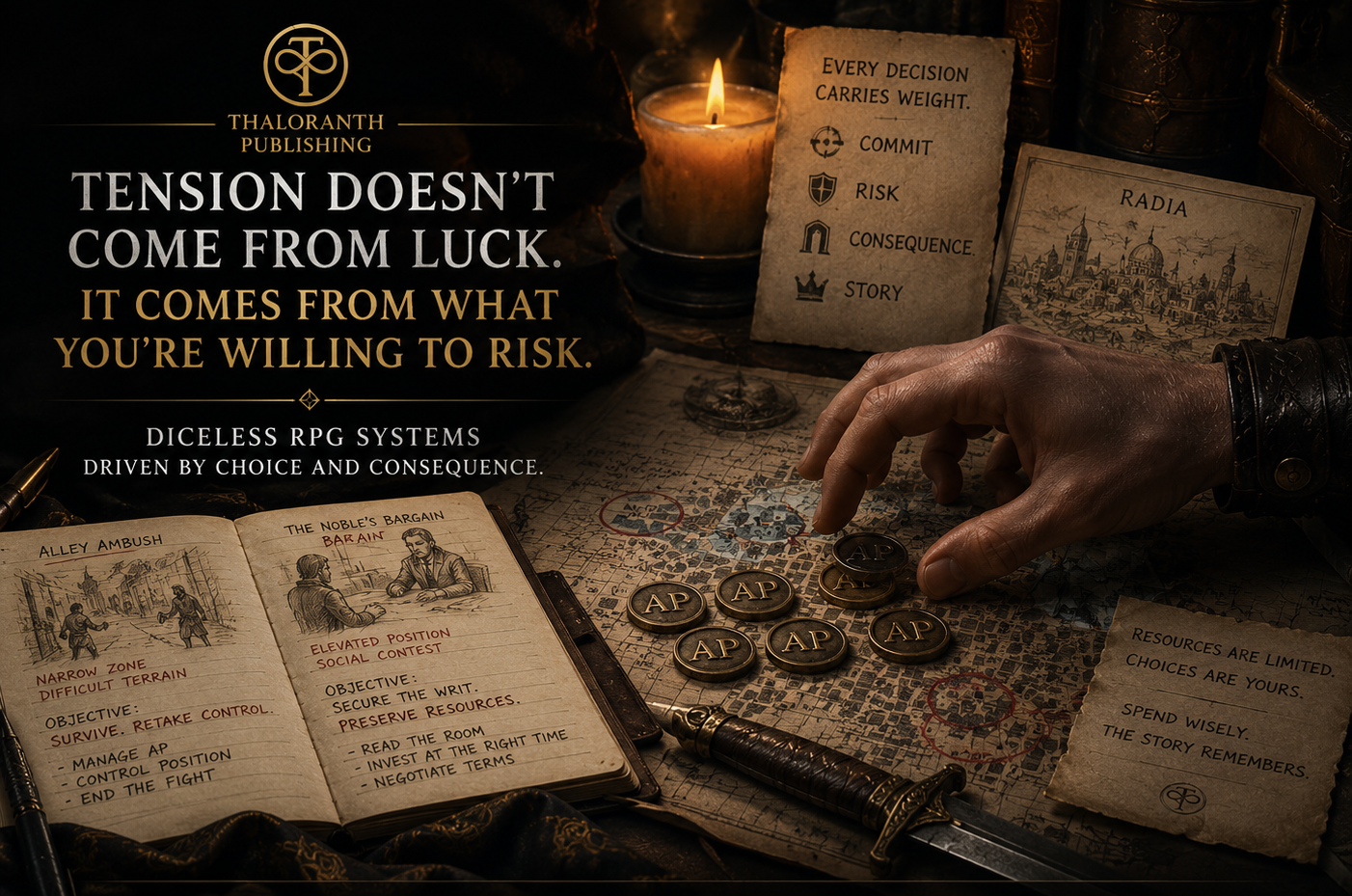
Combat Example: Alley Ambush in Radia
The scene takes place in a narrow back alley behind Radia’s Grand Bazaar (Narrow zone, Difficult Terrain from scattered crates and puddles). Kael (14 AP) and Sira (10 AP) are ambushed by three thugs.
Kael opens aggressively. He commits 4 AP to a powerful strike against the lead thug. He succeeds, driving the thug back into an adjacent Open Courtyard zone and seizing tempo.
Sira, still in the Narrow alley, spends only 1 AP to slip into position and throw a dagger. Her total falls short, and the moment shifts immediately. The thug closes the distance, forcing her to burn 2 more AP on a desperate defense.
By mid-scene, Kael has spent 6 of his 14 AP and Sira has spent 3 of her 10. The remaining thugs are pressing hard. Kael now faces a real choice: commit another 3–4 AP to end the fight quickly, or conserve and risk the enemy gaining the upper hand as resources dwindle?
In a dice-based system, this moment would hinge on a roll. Here, it hinges on a decision.
The tension is palpable because both players know their remaining Action Points are finite.
Social Example: The Noble’s Bargain
The scene takes place in Lord Caelen’s private study (Elevated zone with Concealed alcoves). The characters need a signed writ of passage from the noble to access a restricted warehouse district.
The party’s diplomat opens with a Persuasion check, spending 2 AP. The total falls just short. Lord Caelen leans back, his polite smile fading.
“An interesting proposal… but one does not simply hand over such documents without knowing exactly what one is getting into.”
The failure doesn’t end the conversation, it changes it. The opposition has increased.
The group’s second character steps in, offering valuable information about a rival house while committing 3 AP. The higher investment meets the new, harder DC. Lord Caelen agrees to provide the writ… but not without cost.
“I will give you what you ask. In return, you will deliver a small, sealed package to a contact at the docks tomorrow night. No questions. Fail to do so, and you will find Radia’s doors much less welcoming in the future.”
The outcome wasn’t random, it was negotiated through commitment.
Closing
In both examples, success and failure are not determined by chance. They emerge from what the players chose to commit, and when they chose to commit it.
The tension doesn’t come from hoping for a favorable roll.
It comes from knowing exactly what is at stake, and deciding whether it is worth the cost.
Control vs Chaos
Players crave control in their games, but not all control is equal.
Unlike many traditional games, diceless tabletop RPGs reward planning, timing, and resource management over pure luck.
In many dice-heavy systems, “control” is an illusion. You can build the perfect character, devise a clever plan, and still watch it crumble because of a single bad roll. That’s not meaningful control. That’s chaos dressed up as fairness.
Legends of Thaloranth offers something different: meaningful control.
You don’t get guaranteed success. Difficulty still exists. Opposition is real. The Game Master still sets challenging DCs. But the path to overcoming those challenges is transparent and directly tied to your decisions.
You see the cost upfront. You choose how much to invest. You decide when to push and when to hold back. Success is earned through smart timing and resource management. Failure comes from misjudging the moment, not from bad luck.
This kind of control doesn’t make the game easier. It makes it fairer and more satisfying.
Failure Still Exists
One of the most common objections to diceless systems is:
“But without dice, how do you ever fail?”
The answer is simple: failure comes from the same place success does, your choices.
You can fail by:
Under-committing Action Points when the stakes demanded more
Misjudging the shifting opposition in a scene
Exhausting your resources too early
Making a tactical error in zone positioning
Choosing the wrong moment to push
In Legends of Thaloranth, failure is rarely binary or final. A failed check doesn’t freeze the scene. It redirects it and raises the stakes. A guard becomes suspicious. A noble grows wary and demands concessions. The environment turns against you.
Failure stops being an random accident and becomes a consequence, something you can see coming, react to, and learn from. It carries weight precisely because it resulted from a decision you made, not from a die roll you couldn’t control.
That shift turns failure into part of the story instead of an interruption to it.
Pacing and Flow
Without constant dice rolls, combat rounds, and modifier math, play in Legends of Thaloranth moves faster and feels smoother.
There’s no waiting while someone hunts for the right die, adds up modifiers, or consults multiple tables. Decisions flow naturally from one player to the next. Scenes maintain momentum because the focus stays on choices and consequences rather than mechanical busywork.
This creates deeper engagement. Players stay immersed in the fiction instead of being pulled out by dice resolution. Social scenes breathe and escalate organically. Combat feels dynamic and tactical rather than a slow war of attrition.
The result is cleaner pacing, stronger narrative flow, and more room for roleplaying, all while keeping the underlying gameplay sharp and strategic.
Who Diceless Tabletop RPGs Are For
Diceless systems aren’t for everyone, and that’s okay.
Legends of Thaloranth works best for players who enjoy strategy, planning, and meaningful consequences. It rewards people who like thinking several moves ahead, managing limited resources, and taking ownership of both their successes and their failures.
It shines especially bright for:
Players who get frustrated when a clever plan dies to a bad roll
Solo players who want rich, satisfying adventures without needing extra subsystems
Groups that value tactical depth and strong roleplaying over random chaos
Game Masters who want tools that support consistent, dramatic pacing
On the other hand, if you primarily love the wild swing of dice, the thrill of “let’s roll and see what happens,” or games where randomness can produce hilarious or unexpected results, this system may not be the best fit.
Being honest about this upfront builds trust. Legends of Thaloranth isn’t trying to be all things to all people. It is built for players who want their decisions to matter, every single time.
The Big Shift
This is the heart of the entire philosophy.
Traditional RPGs are largely luck-driven. Your prep, your strategy, and your roleplaying can be overruled at any moment by the dice.
Legends of Thaloranth is decision-driven.
You don’t hope the dice favor you.
You don’t pray for a good roll when it counts.
Instead, you evaluate the situation, weigh your resources, and decide exactly how much you are willing to commit. The outcome flows directly from that choice.
You don’t hope for the outcome, you create it.
That single shift changes everything about how the game feels. Responsibility moves from the dice back to the players. Tension becomes personal. Victories feel earned. Failures feel fair. The story belongs to the people at the table, not to random chance.
Dice are not required for tension or excitement. They are simply one tool, and often a blunt one.
Legends of Thaloranth replaces randomness with something more powerful: meaningful player decisions backed by limited resources, transparent difficulty, and real consequences.
This is why Action Points exist.
This is why scenes, rather than rounds, form the backbone of play.
This is why the system was deliberately built to support solo, group, and hybrid play without compromise.
The best diceless tabletop RPGs simply create tension differently.
If you’re tired of watching good plans die to bad rolls, or if you want a game where your choices consistently drive the story, Legends of Thaloranth offers a refreshing and deeply satisfying alternative.
Ready to experience the difference?
Start with the first post in this series What Is Legends of Thaloranth? then grab the Player’s Guide and Game Master’s Guide on Gumroad.
Your decisions are waiting.
Looking for something different from traditional RPG systems?
Legends of Thaloranth and Starburn Sector feature diceless, AP-driven gameplay built for meaningful choices, structured scenes, and both solo and group play.
Join the Thaloranth Review Guild to receive review copies and help shape the future of the system.
Apply here
Curious about the philosophy behind Legends of Thaloranth? Read the recent Q&A discussing the system’s design, solo play, and diceless approach.
Leave a Reply