A Complete Example of Play in Legends of Thaloranth
Introduction
After exploring the core systems of Legends of Thaloranth, the next question is a natural one: What does an actual game look like? Reading about scenes, Action Points, combat, and character advancement provides an understanding of the rules, but seeing those ideas work together during an adventure reveals how the game is truly played. This example of play demonstrates how the game’s mechanics support the story without ever becoming the story themselves.
Rather than examining individual rules in isolation, we’ll follow a complete adventure from beginning to end. Along the way, you’ll see how scenes are framed, how players make meaningful decisions, how Action Points influence every challenge, and how the Game Master guides the story forward. Every mechanic exists to support the adventure, allowing the narrative to develop naturally through the choices made by the players.
Our example of play takes place in Radia, the capital of Thaloranth and one of the busiest cities in Vaeloraranth. Its bustling streets, thriving guilds, and countless opportunities make it an ideal place for a new adventure to begin. Like many adventures in Legends of Thaloranth, this story starts with an ordinary opportunity rather than an extraordinary prophecy. What transforms it into a memorable adventure isn’t fate or random chance—it’s the decisions made along the way.
Before we begin, remember that this article is meant to demonstrate the natural flow of play rather than teach every rule in detail. If you’d like a closer look at how scenes are structured, be sure to read What a Scene Looks Like in Legends of Thaloranth. For a deeper explanation of how player choices are shaped by the Action Point system, our article Action Points: The Core of Every Decision in Legends of Thaloranth explores that philosophy in detail. Those articles provide the foundation; this example of play shows how everything comes together at the table.
Before Play Begins
Meet Our Adventurer
Every adventure in Legends of Thaloranth begins with a character who has a reason to become involved in the world around them. For this example of play, we’ll follow Kaelen, a young traveler who recently arrived in Radia hoping to earn an honest living and build a reputation through his own efforts. He isn’t a legendary hero, a noble heir, or the subject of an ancient prophecy. Like most beginning adventurers, he’s simply looking for an opportunity to prove himself.
Kaelen was created using the standard character creation rules found in the Player’s Guide, selecting an Origin, assigning his Stats, choosing his starting skills, and beginning his journey along a Path. Rather than reproducing those steps here, we’ll focus on how those choices influence play. If you’d like to see how quickly a new character comes together, our article Character Creation in 15 Minutes in Legends of Thaloranth walks through the entire process.
An Opportunity in the Grand Marketplace
Like many adventures in Legends of Thaloranth, this story begins with something small.
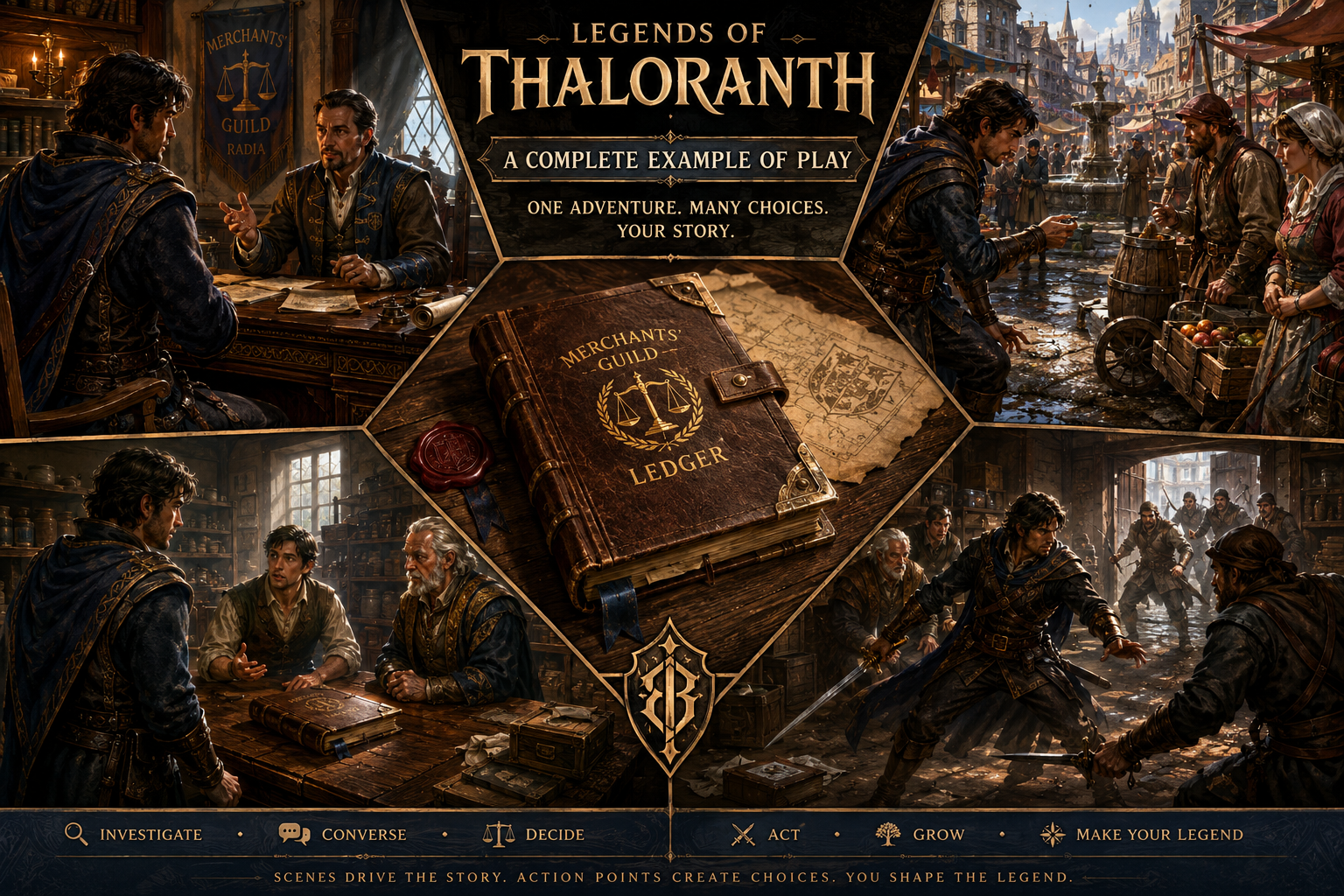
While walking through the bustling Grand Marketplace, Kaelen notices a posting from the Merchants’ Guild seeking someone willing to recover an important ledger that disappeared before it could reach its intended recipient. The missing document contains shipping agreements and trade records rather than hidden treasure, but recovering it quickly could prevent costly disputes between several respected merchants.
For Kaelen, the reward is only part of the appeal. More valuable is the chance to earn the trust of one of Radia’s most influential guilds. Every successful job helps establish a reputation, and every reputation begins with someone willing to take a chance on an unknown adventurer.
Curious, Kaelen accepts the invitation to meet with the guild representative and learn the details of the assignment.
Framing the Opening Scene
At this point, the Game Master has everything needed to begin the adventure. The player understands why Kaelen has become involved, the objective is clearly established, and the situation presents meaningful stakes without relying on an immediate threat to the kingdom or the world. Instead of beginning with drawn swords or desperate battles, the story opens with a conversation, a mystery, and an opportunity to make a name for oneself.
That approach reflects one of the central ideas behind Legends of Thaloranth. Scenes are designed around meaningful decisions, not around predetermined combat encounters. Sometimes those decisions lead to negotiations, sometimes to investigations, and sometimes to conflict, but every scene begins with a purpose that moves the story forward. If you’d like to explore that design philosophy in greater detail, be sure to read What a Scene Looks Like in Legends of Thaloranth. Likewise, our article Social Encounters That Actually Matter in Legends of Thaloranth explains how conversations can become just as important as battles in shaping the outcome of an adventure.
Example of Play: The First Conversation
Meeting the Guild Representative
Inside the Merchants’ Guild office, Kaelen is greeted by Derrick Halwen, a senior clerk responsible for coordinating local trade records and deliveries. Rather than immediately offering the assignment, Derrick begins by asking a few questions about Kaelen’s background. Has he worked for any guilds before? Does he know the city? Why is he looking for work?
The conversation serves two purposes. For Derrick, it is an opportunity to determine whether Kaelen can be trusted with sensitive business. For the player, it is the first opportunity to define the character’s personality through roleplaying. Kaelen’s responses may be confident, cautious, humble, or ambitious, and each approach helps establish who the character is before a single challenge is overcome.
This is one of the defining characteristics of Legends of Thaloranth. Characters are not introduced by their statistics alone. They are introduced through the decisions they make and the impressions they leave on the people they meet.
Gathering the Facts
Once Derrick is satisfied that Kaelen deserves a chance, he explains the situation.
Earlier that morning, a courier carrying an important trade ledger failed to arrive at its destination in the Grand Marketplace. The courier never reported an attack, no signs of violence have been found, and nothing suggests the ledger was stolen for its monetary value. Nevertheless, the document contains agreements between several respected merchants, and if it cannot be recovered quickly, confusion and mistrust could spread throughout the district.
Rather than instructing Kaelen exactly where to go, Derrick shares everything the guild currently knows and leaves the investigation in the adventurer’s hands. The objective is clear, but the solution is entirely up to the player.
Why This Example of Play Begins with Conversation
Many roleplaying games begin by placing enemies directly in front of the characters. This example of play begins differently because the first meaningful decision is not how to win a fight, but how to understand a problem.
By opening the adventure with conversation instead of combat, the Game Master establishes the objective, introduces important NPCs, and gives the player an opportunity to gather information before deciding what to do next. If you’d like to explore this philosophy in greater depth, our article Social Encounters That Actually Matter in Legends of Thaloranth explains how meaningful conversations become an essential part of every adventure.
Example of Play: Following the First Lead
Choosing Where to Begin
With the conversation complete, the first scene comes to a natural close. Kaelen knows what was lost, why recovering it matters, and where the courier was expected to make the final delivery. What he doesn’t know is what happened between those two points.
Instead of directing Kaelen toward a predetermined solution, the Game Master turns the decision back to the player.
“Where would you like to begin?”
That simple question shifts the focus from receiving instructions to making choices. Kaelen could retrace the courier’s route through the Grand Marketplace, speak with nearby merchants, visit the intended recipient, or look for members of the City Watch who may have responded to an earlier disturbance. Each option is reasonable, and each has the potential to uncover different pieces of information.
This freedom to choose an approach is one of the defining characteristics of Legends of Thaloranth. The Game Master presents the situation, but the player decides how to engage with it.
Searching the Grand Marketplace
Kaelen decides to begin where the courier was last expected to arrive.
The Grand Marketplace is already alive with activity as merchants arrange their stalls, wagons unload fresh goods, and customers weave through the crowded streets. Street performers compete with merchants advertising their wares, while guild representatives move from shop to shop conducting the day’s business. Finding one missing courier among hundreds of people will require careful observation rather than blind luck.
Rather than searching every street at random, Kaelen begins speaking with nearby shopkeepers and vendors whose businesses overlook the delivery route. Some remember seeing the courier earlier that morning. Others recall a brief argument near a public fountain before the courier disappeared into the crowd. Individually, each conversation provides only a small piece of the puzzle. Together, they begin to establish a timeline of events.
The investigation is beginning to take shape.
Every Choice Creates New Opportunities
At this stage of the adventure, the Game Master still hasn’t decided how Kaelen will solve the mystery. Instead, each decision made by the player uncovers new information that naturally points toward the next scene.
That flexibility is one of the reasons scenes work so well in Legends of Thaloranth. Every scene begins with a clear purpose, but the path through it is shaped by the player’s decisions rather than by a scripted sequence of events. If you’d like to learn more about how scenes are designed to support that style of play, see What a Scene Looks Like in Legends of Thaloranth.
Example of Play: A Meaningful Skill Check
Looking Beyond the Obvious
After speaking with several merchants, Kaelen has assembled a rough picture of the courier’s final movements. Witnesses agree that the courier crossed the marketplace shortly after sunrise, paused briefly near the central fountain to speak with someone they couldn’t identify, and then disappeared into the morning crowd. No one remembers seeing a struggle, hearing raised voices, or watching anyone flee the area.
Something about the story doesn’t fit.
Rather than questioning more bystanders, Kaelen decides to examine the area for details everyone else overlooked. The Game Master agrees that this is an appropriate use of the Investigation skill and asks for a Skill Check using the rules presented in the Player’s Guide.
The check succeeds.
Instead of discovering a dramatic clue, Kaelen notices something subtle. One of the merchant carts parked beside the fountain has fresh mud along its wheels, far more than the surrounding streets would explain. A narrow trail of dried footprints leads away from the cart toward a quieter side street, suggesting that the missing courier may have left the marketplace voluntarily rather than being forced away.
The discovery doesn’t solve the mystery, but it changes the direction of the investigation. Kaelen now has a promising lead to follow, and the next scene naturally grows from the information uncovered during this one.
Success Moves the Story Forward
One of the defining features of Legends of Thaloranth is that a successful Skill Check does more than answer a simple yes-or-no question. It provides information that helps the player make better decisions while allowing the story to continue unfolding naturally.
The important moment isn’t the check itself. The important moment is what the player chooses to do with the new information. Every discovery creates another decision, and every decision shapes the adventure in ways that neither the player nor the Game Master could have predicted at the beginning of the session.
If you’d like to explore the game’s resolution system in greater detail, our article Action Points: The Core of Every Decision in Legends of Thaloranth explains how meaningful choices and Skill Checks work together to keep the focus on the story rather than on chance.
Example of Play: A Decision That Changes the Adventure
Following the New Trail
The fresh footprints lead Kaelen away from the noise of the Grand Marketplace and into one of Radia’s quieter commercial streets, where warehouses, counting houses, and workshops stand shoulder to shoulder behind sturdy timber doors. The sounds of merchants calling to customers gradually fade, replaced by the steady rhythm of craftsmen at work and wagons moving supplies through the district. Before long, the trail ends outside an unremarkable warehouse whose heavy doors have been left slightly ajar.
Nothing about the scene suggests violence. There are no signs of a struggle, no broken crates scattered across the street, and no anxious crowds gathering nearby. Whatever happened here appears to have unfolded calmly, a realization that immediately challenges Kaelen’s assumption that the missing courier had been robbed or attacked.
Rather than deciding what happens next, the Game Master simply describes what Kaelen can see and asks a familiar question.
“What would you like to do?”
That question is one of the defining moments in Legends of Thaloranth. The Game Master presents the world honestly, but the player decides how to engage with it. There is no predetermined solution waiting to be discovered—only a situation that will change according to the decisions the character makes.
Every Choice Shapes the Story
Standing outside the warehouse, Kaelen pauses to consider his options. He could remain outside and watch the building for a few minutes, hoping to learn who is inside before revealing himself, he could announce his presence immediately and attempt to resolve the situation through conversation, he might even decide that the information he has already uncovered is enough to report back to the Merchants’ Guild before taking any unnecessary risks.
Each approach is reasonable, and each would lead the adventure in a different direction. Instead of searching for the “correct” answer, the player is choosing what kind of story this becomes. That distinction lies at the heart of Legends of Thaloranth, where meaningful decisions shape the adventure far more than hidden solutions or predetermined outcomes.
After considering the possibilities, Kaelen decides that the best way to learn the truth is to walk through the open doorway and speak with whoever is inside.
The Mystery Changes
The warehouse is quieter than Kaelen expected. Sunlight filters through high windows, illuminating shelves lined with trade goods awaiting shipment. Near the center of the room, the missing courier sits across a table from an elderly merchant. Between them rests the missing ledger, untouched and exactly where Kaelen hoped to find it.
Neither person reacts with panic as Kaelen enters. Instead, both look up with expressions of surprise, as though they had expected someone to arrive eventually but not quite so soon. Before Kaelen has an opportunity to introduce himself, the courier gently places a hand on the ledger.
“I know why you’ve come,” he says. “But before you decide what to do, I think you deserve to hear why I never completed the delivery.”
In that moment, the adventure changes. Recovering the ledger is no longer the only question that matters. The player must now decide whether to listen, whom to trust, and how those answers should influence everything that follows.
Example of Play: The Choice Before Conflict
Listening Before Acting
Rather than immediately reaching for his weapon or demanding the ledger, Kaelen chooses to hear the courier’s explanation. The Game Master shifts the focus from investigation to conversation, giving the player an opportunity to gather information before making a decision that could affect everyone involved.
The courier explains that he never intended to steal the ledger. During his delivery route, he discovered that one of the agreements recorded within it had been altered shortly before it left the Merchants’ Guild. The changes would transfer ownership of several valuable shipments to another merchant through language so subtle that few people would notice until the contracts were enforced. Unsure whom he could trust, the courier sought out an older merchant whose reputation for honesty was well known throughout the district. Together, they intended to compare the ledger against earlier records before returning it to the guild.
The elderly merchant quietly confirms the story, producing an older copy of the agreement that reveals the discrepancies. What first appeared to be a simple missing delivery has become evidence that someone may be attempting to manipulate the guild’s records for personal gain.
Every Conversation Has Consequences
The Game Master now presents Kaelen with a meaningful decision.
Does he immediately return the ledger to the Merchants’ Guild as requested? Does he remain with the courier while the evidence is examined more carefully? Or does he attempt to determine who altered the document before anyone realizes the deception has been discovered?
Each option carries different risks, and none is presented as the obvious choice. Instead, the Game Master explains what Kaelen understands about the situation and then allows the player to decide how the story continues.
This approach reflects the philosophy behind Legends of Thaloranth. Important decisions rarely arise because the rules demand them. They emerge naturally from the people, places, and circumstances the characters encounter. The mechanics support those decisions, but they never replace them.
If you’d like to explore how conversations become pivotal moments in an adventure, our article Social Encounters That Actually Matter in Legends of Thaloranth examines how meaningful dialogue can shape an entire campaign.
When the Situation Changes
As Kaelen considers the evidence spread across the table, hurried footsteps echo from outside the warehouse. A moment later, the front doors swing open, and several armed figures step inside. Their eyes move immediately to the ledger resting on the table.
One of them points toward the courier.
“Take the book.”
In an instant, the conversation gives way to a new scene.
No one at the table expected combat when the adventure began, yet the story has naturally arrived at that possibility through the choices made by its characters. The investigation uncovered the truth, the conversation revealed what was truly at stake, and now Kaelen must decide how far he is willing to go to protect people he met only moments before.
Example of Play: When Words Give Way to Action
A New Scene Begins
The arrival of the armed strangers marks the end of one scene and the beginning of another. Up to this point, the adventure has focused on gathering information, asking questions, and deciding whom to trust. Those choices have now changed the situation, creating an entirely new challenge for both the player and the Game Master.
Rather than continuing the previous conversation indefinitely, the Game Master frames a new scene with a different objective. The goal is no longer discovering what happened to the missing ledger. The immediate question has become far more urgent.
Can Kaelen prevent the ledger from falling into the wrong hands?
This transition illustrates one of the defining strengths of scene-based play. As the story changes, the focus of play changes with it, allowing each scene to concentrate on a single dramatic question before naturally giving way to the next. If you’d like to explore this structure in greater detail, see What a Scene Looks Like in Legends of Thaloranth.
Combat Serves the Story
The strangers advance into the warehouse with clear purpose, demanding the ledger and ordering everyone else to stand aside. Kaelen has only moments to react. He could comply and surrender the book, attempt to delay the intruders through conversation, position himself between the attackers and the courier, or prepare to defend the people in the room if negotiations fail.
The player chooses to stand his ground.
Only now does the Game Master transition into the combat rules described in the Player’s Guide. Combat has not appeared because every adventure requires a fight. It has appeared because every other reasonable option has been exhausted, and the decisions made by everyone involved have led naturally to conflict.
That distinction is important. In Legends of Thaloranth, combat is another way of resolving a scene, not the purpose of the scene itself.
Every Action Matters
As the confrontation begins, Kaelen must decide how to spend his available Action Points. Moving into a better position, protecting the courier, closing with an opponent, or saving Action Points for later in the scene are all meaningful choices, and each one carries consequences that may influence everything that follows.
There is no single optimal sequence that guarantees success. Instead, the player continually weighs immediate needs against future opportunities, adapting as the situation changes around the character. The tension comes not from hoping for favorable dice, but from deciding where each Action Point will have the greatest impact.
Our article Action Points: The Core of Every Decision in Legends of Thaloranth explores this system in depth, but seeing it unfold during an actual example of play demonstrates why it sits at the heart of the game’s design philosophy.
The Scene Reaches Its Resolution
After a brief but determined struggle, the intruders realize they have lost the advantage. One flees through the warehouse door while the others quickly follow, abandoning their attempt to seize the ledger. The courier and the elderly merchant are unharmed, and the ledger remains safely in Kaelen’s possession.
Although the attackers escape, the scene has reached its natural conclusion. The immediate danger has passed, the central question has been answered, and the story is ready to move forward. The purpose of the encounter was never to defeat every opponent. It was to determine whether Kaelen could protect the ledger and the people entrusted with it.
That outcome, rather than the number of enemies defeated, is what gives the scene its meaning.
Example of Play: Bringing the Adventure to a Close
Returning to the Merchants’ Guild
With the immediate danger behind them, Kaelen accompanies the courier and the elderly merchant back to the Merchants’ Guild, carrying both the recovered ledger and the evidence that someone attempted to alter its contents. What began as a straightforward recovery quickly becomes an internal investigation as guild officials compare the forged agreements with their official records.
The guild representative who first entrusted Kaelen with the assignment listens carefully as each person recounts the day’s events. The courier explains why he chose to withhold the ledger, the elderly merchant presents the original agreements that exposed the deception, and Kaelen describes the investigation that led him to the warehouse and the confrontation that followed.
By the time the discussion ends, it is clear that recovering the ledger was only part of what the guild truly needed. More important was discovering that someone had attempted to exploit the trust on which the city’s commerce depends.
Success Means More Than a Reward
The Game Master now brings the adventure to its natural conclusion.
Kaelen receives the promised payment for completing the assignment, but the coins themselves are only one part of the reward. More valuable is the confidence he has earned from the people who placed their trust in him. The guild now knows his name, the courier leaves with his reputation restored, and the elderly merchant has gained a new reason to recommend Kaelen whenever honest work requires someone dependable.
These outcomes illustrate an important principle of Legends of Thaloranth. Adventures do not end simply because the immediate challenge has been overcome. They end with the world in a different state than it was when the first scene began. Relationships have changed, new opportunities have emerged, and the character has become part of the living world rather than merely passing through it.
Character Growth Through Experience
With the final scene complete, the Game Master awards Experience Points for the adventure. Those points represent more than victories in combat or successful Skill Checks. They reflect the character’s participation in meaningful scenes, thoughtful decision-making, and successful resolution of the challenges presented throughout the adventure.
As future adventures unfold, those Experience Points will allow Kaelen to continue developing in ways that reflect the story he has lived rather than following a predetermined path of advancement. If you’d like to explore that system in greater detail, our article Advancement in Legends of Thaloranth: Growth Without Levels explains how experience becomes a flexible resource that supports long-term character development.
Why This Example of Play Matters
This example of play demonstrates that a memorable adventure doesn’t require legendary heroes or world-ending threats. A missing ledger, a handful of honest citizens, and a difficult decision were enough to create an adventure filled with investigation, roleplaying, meaningful choices, and conflict, all while remaining firmly rooted in the everyday life of Radia.
More importantly, every major system in Legends of Thaloranth worked together to support the story. Scenes gave the adventure its structure, conversations revealed the mystery, Action Points shaped meaningful decisions, combat emerged naturally from the characters’ choices, and Experience Points reflected the lessons learned along the way. At no point did the mechanics replace the story—they simply provided the framework that allowed it to unfold.
Whether your adventures begin with missing ledgers, political intrigue, forgotten ruins, or dangerous expeditions beyond the walls of civilization, the same philosophy remains at the heart of every game: meaningful decisions create memorable stories.
Continue Your Journey
This example of play demonstrates how the core systems of Legends of Thaloranth work together to create adventures driven by meaningful decisions. Rather than separating exploration, social interaction, combat, and character growth into isolated systems, the game unifies them through a scene-based structure that keeps the focus on the story unfolding at the table.
Whether you’re creating your first character, preparing your first adventure, or introducing a new group to the game, the complete rules can be found in the Player’s Guide and Game Master’s Guide. Together, they provide everything needed to explore the world of Vaeloraranth, build memorable adventures, and create stories shaped by the choices your characters make.
Prefer a printed edition? The Player’s Guide, Game Master’s Guide, and many other Legends of Thaloranth titles are also available through Lulu, making it easy to build your collection in the format that best fits your gaming table.
Every memorable campaign begins with a single scene.
Every unforgettable story begins with a single decision.
Now it’s time to create your own.
Leave a Reply
You must be logged in to post a comment.