Introduction
Solo play in Legends of Thaloranth is not a compromise. It is not a reduced version of the game, nor is it a temporary substitute for a group. It is a complete roleplaying experience designed to create meaningful stories through exploration, discovery, and consequence.
Many roleplaying games assume that a Game Master is required to create uncertainty. The GM presents challenges, controls non-player characters, introduces complications, and determines how the world responds to the characters’ actions. Without that external voice, it is easy to assume that surprise disappears and the experience becomes predictable.
Legends of Thaloranth approaches the problem differently.
Instead of relying on a Game Master to create uncertainty, solo play uses the Radia Mysteries Oracle Deck and the 2d6 Fate System to generate unexpected developments, answer questions about the world, and introduce complications that the player could not have planned for in advance. The result is a style of play where discovery remains just as important as it is in a traditional group campaign.
At the same time, solo play still uses the same foundations that drive every other part of the game. Scenes create structure. Action Points create meaningful decisions. Consequences shape future opportunities. The tools may be different, but the core philosophy remains the same. Every choice matters because every choice changes something.
In this article, we will explore what makes solo play in Legends of Thaloranth unique, how the Oracle system creates uncertainty, and why solo campaigns can become just as rich and rewarding as adventures shared around a table with friends.
What Makes Solo Play in Legends of Thaloranth Different?
Many people encounter the idea of solo roleplaying and immediately ask the same question.
If there is no Game Master and no other players, what creates uncertainty?
At first glance, the concern seems reasonable. Traditional roleplaying games generate surprise through the actions of other people. Players make unexpected choices. Game Masters introduce unforeseen complications. The story develops through the interaction of multiple perspectives around the table.
Solo play approaches that challenge from a different direction.
Solo Play Is Not a Lesser Version of the Game
One of the first points made in the Solo Rules Source Book is that solo roleplaying is not a compromise. It is a different kind of game. Rather than removing part of the roleplaying experience, solo play shifts the source of uncertainty from other participants to the systems that drive the world itself.
In a group campaign, the story emerges through conversations, decisions, and interactions between players and the Game Master. In solo play, the story emerges through the interaction between the player, the character, and the Oracle. The experience is different, but the goal remains the same: creating meaningful stories through meaningful choices.
This distinction is important because it changes how solo play should be approached.
The objective is not to replicate a group game as closely as possible. The objective is to embrace the strengths of a format that allows exploration, experimentation, and discovery at your own pace while still preserving uncertainty and consequence.
Surprise Still Exists
The absence of a Game Master does not eliminate surprise.
In fact, some solo players discover that uncertainty becomes one of the most enjoyable aspects of the experience.
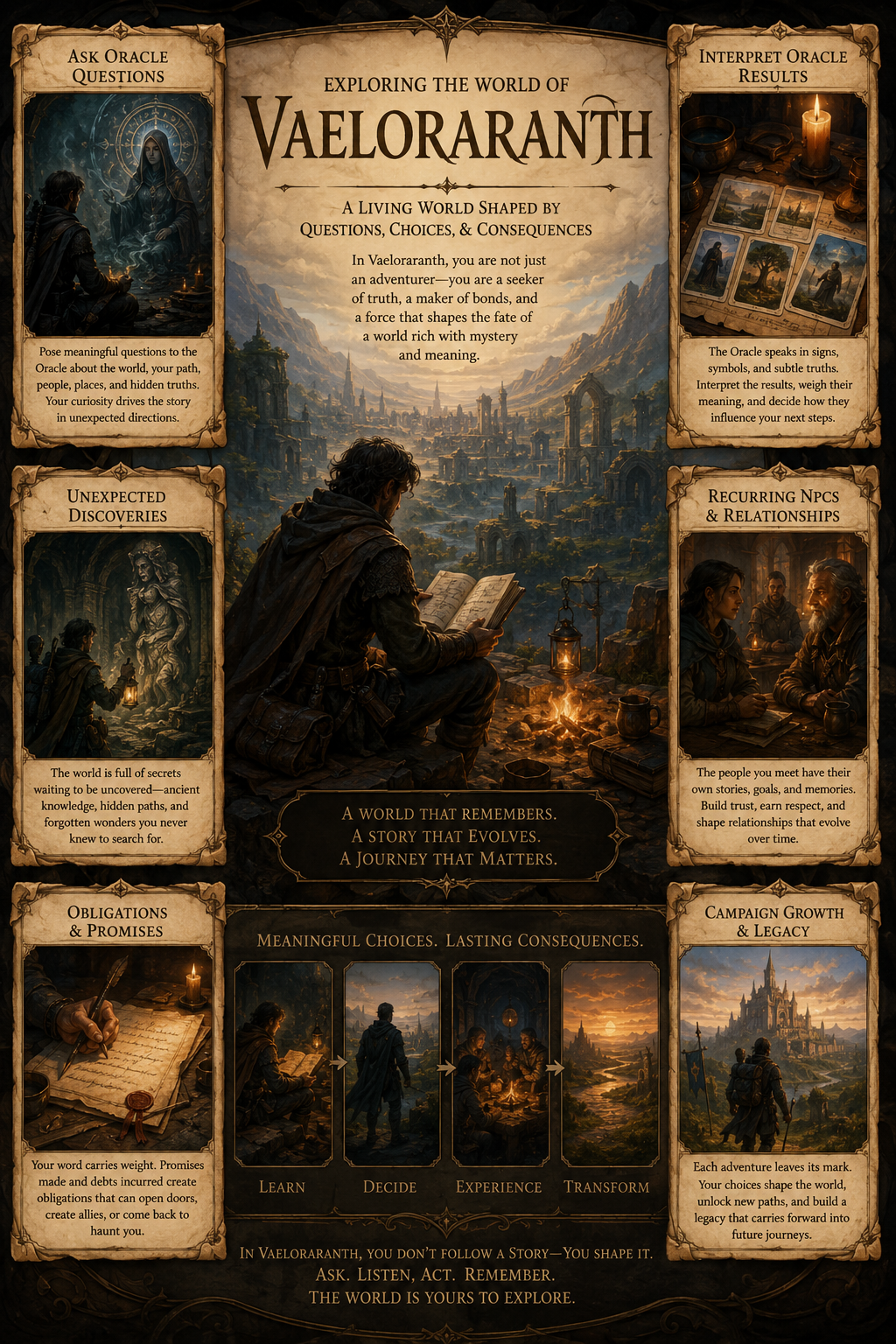
The Oracle continually introduces information that the player did not anticipate. A straightforward investigation may uncover an unexpected discovery. An ally may react differently than expected. A situation that seemed simple may reveal hidden complications. These developments occur because the Oracle answers questions about the world independently of what the player hopes will happen.
This creates a dynamic that feels remarkably similar to traditional roleplaying. The player still makes plans. The character still pursues goals. The difference is that the world retains the ability to respond in unexpected ways.
That ability to surprise the player is what transforms solo play from a writing exercise into a genuine game.
The story is not being scripted in advance.
It is being discovered through play.
The Oracle Creates Uncertainty
The Oracle is the engine that makes solo play possible.
Without it, every question about the world would have to be answered by the player. While that might sound simple, it creates a problem. If the player always decides what happens next, surprise begins to disappear. The experience gradually shifts from roleplaying into planning.
The Solo Rules Source Book solves this problem through the Oracle system. The Oracle answers questions the player cannot answer honestly for themselves. It determines how circumstances develop, how NPCs react, whether plans succeed, and what unexpected developments emerge along the way.
Most importantly, the Oracle creates uncertainty without taking away player agency. The player still chooses what their character attempts. The Oracle helps determine how the world responds.
The Oracle Is Not the Story
One of the most important ideas in the Solo Rules Source Book is that the Oracle does not tell the story. It generates the raw material that the player transforms into a story through interpretation and play.
This distinction is easy to overlook, but it sits at the center of the entire solo experience.
When the Oracle produces a result, it rarely provides a complete narrative. Instead, it introduces information, circumstances, or possibilities that the player must interpret within the context of the current situation. The Oracle might reveal a complication, uncover a discovery, or suggest an unexpected reaction from an NPC. The meaning of that result emerges through play.
This approach keeps the player actively engaged in the creative process. Rather than following a predetermined script, they are constantly interpreting new information and deciding how their character responds to it.
Story Mode and Fate Mode
The Radia Mysteries Oracle Deck operates through two complementary approaches.
Story Mode answers questions about what exists within the world. It generates hooks, complications, settings, discoveries, and NPC reactions that help build adventures and scenes. These results are not pass-or-fail outcomes. They are narrative prompts that expand the situation and introduce new possibilities.
Fate Mode answers a different kind of question.
Instead of asking what exists, Fate Mode answers whether something happens. Does the guard believe the story? Is the door unlocked? Has the contact arrived on time? These questions receive answers through Fate draws or the 2d6 Fate System, allowing the world to respond independently of the player’s expectations.
Together, these two approaches allow the Oracle to function as both a source of information and a source of uncertainty.
Unexpected Results Create Better Stories
One of the strengths of the Oracle system is its ability to introduce developments that the player would never have planned for themselves.
The Solo Rules Source Book includes tools such as Scene Checks, Discoveries, Complications, and NPC Reactions that continually challenge assumptions about what will happen next. A scene that appears straightforward may suddenly take an unexpected turn. A plan that seemed certain may encounter an unforeseen obstacle. An NPC who appeared trustworthy may react in a surprising way.
These moments create the same sense of discovery that many players enjoy in traditional group campaigns.
The player enters a scene with expectations.
The Oracle introduces uncertainty.
The story emerges from the difference between the two.
Solo Play Uses the Same Foundation as Every Other Game
One of the greatest strengths of solo play in Legends of Thaloranth is that it does not require players to learn an entirely separate game.
The Oracle introduces uncertainty. The Solo Rules provide structure. Yet beneath those additions, the same core systems that drive group play remain firmly in place. Characters still face challenges. They still make meaningful decisions. They still experience consequences that shape future opportunities.
The tools used to answer questions may be different, but the foundation of play remains remarkably familiar.
Scenes Still Drive Play
As explored in What a Scene Looks Like in Legends of Thaloranth, scenes are the fundamental unit of play throughout the system.
The Solo Rules Source Book embraces that same philosophy. Solo sessions are built from scenes with clear beginnings, developments, and conclusions. Each scene exists to establish something meaningful, create a challenge, reveal new information, or change the situation in some important way.
The book even recommends a three-scene session structure. An opening scene establishes the situation. A second scene introduces complications or discoveries. A final scene resolves the immediate problem while creating new questions and opportunities for future adventures.
This approach keeps solo play focused on meaningful moments rather than endless travel, bookkeeping, or activities that do not move the story forward.
Action Points Still Matter
The Action Point system remains just as important during solo play as it is during group play.
Characters continue to spend Action Points when attempting difficult tasks, overcoming obstacles, and pushing toward desired outcomes. Every point spent represents a meaningful choice because those resources remain limited within the scene.
This creates the same tension found throughout the rest of the game. Should resources be spent now to secure success, or saved for a challenge that may emerge later? The Oracle may introduce surprises, but it does not remove the need for careful decision-making.
Meaningful choices remain meaningful because resources remain finite.
Consequences Still Matter
Perhaps most importantly, consequences continue to drive the story.
The Game Master’s Guide emphasizes that failure should not stop the story. Instead, failure introduces complications, costs, and new directions for play. The Solo Rules apply the same philosophy. When plans go wrong, the story moves forward through discoveries, complications, changing circumstances, and unexpected developments.
This connection is one of the reasons solo play feels so similar to a traditional campaign. The character is not moving through a predetermined sequence of events. They are responding to a world that changes in response to their choices.
Whether playing alone or with a group, the same principle remains true.
Meaningful stories emerge when meaningful choices produce meaningful consequences.
Discovery Becomes the Adventure
Traditional adventures often begin with a clear objective.
Recover the artifact. Defeat the bandits. Solve the murder. Deliver the message.
While solo campaigns can certainly begin with those kinds of goals, the Solo Rules Source Book encourages a broader way of thinking about adventure. Rather than focusing exclusively on the destination, solo play places equal importance on what is discovered along the way. New information, unexpected complications, and changing circumstances frequently become just as important as the objective that started the journey.
This shift is one of the reasons solo campaigns often develop in surprising directions. The player may begin with a plan, but the Oracle continually introduces new information that reshapes both the situation and the decisions available moving forward.
The World Reveals Itself Through Questions
Questions sit at the center of the solo experience.
Some questions are immediate and practical. Does the guard believe the story? Is the warehouse occupied? Has the contact arrived on time? Others are broader and help shape the adventure itself. What draws the character into this situation? What unexpected complication emerges? What discovery changes their understanding of the problem? The Oracle provides answers, but those answers frequently generate new questions that push the story in unexpected directions.
Because of this, curiosity becomes one of the most valuable tools available to a solo player. The more actively a player engages with the world and asks meaningful questions, the more opportunities exist for the story to evolve in ways that could not have been anticipated at the beginning of the session.
Complications Create Momentum
Complications are often viewed as obstacles that stand between a character and their objective. In practice, they serve a much more important purpose.
The Solo Rules Source Book uses complications to introduce uncertainty, redirect expectations, and prevent situations from becoming predictable. A straightforward investigation may reveal a second mystery. A trusted ally may arrive with their own agenda. A simple delivery may become entangled in faction politics. The original objective remains, but the situation surrounding that objective becomes richer and more interesting.
These developments create momentum because they continually present the player with new decisions. Rather than following a fixed path from beginning to end, the character must adapt to changing circumstances and respond to information that was unavailable only moments earlier. The resulting story feels dynamic because it develops through play rather than following a predetermined sequence of events.
Discoveries Change Direction
One of the most valuable rewards in Legends of Thaloranth is information.
The Solo Rules Source Book embraces this idea by treating discoveries as major drivers of adventure. A discovery may reveal hidden information, expose a misunderstanding, uncover a new opportunity, or transform the player’s understanding of what is actually happening. Because new information changes how situations are understood, discoveries often become turning points within a campaign.
A character investigating a missing shipment may learn that the shipment was never stolen. An ally may turn out to be protecting a secret rather than withholding information. What initially appeared to be a simple problem may reveal connections to larger events, factions, or obligations. The discovery itself becomes important because it changes the decisions available moving forward.
This is one of the defining strengths of solo play in Legends of Thaloranth. The adventure does not emerge from a predetermined plot. Instead, it develops through an ongoing process of asking questions, interpreting answers, and responding to new information. As the character’s understanding of the situation grows, the story grows with it.
Over time, those discoveries create a campaign that feels both surprising and earned. The player is not following a script. They are uncovering a world that reveals itself through curiosity, consequence, and exploration.
Solo Campaigns Grow Over Time
One of the most common misconceptions about solo roleplaying is that it consists primarily of isolated adventures.
A character explores a location, resolves a problem, records the outcome, and then begins an entirely new story during the next session. While solo play can certainly be enjoyed this way, the Solo Rules Source Book is designed to support something much larger: ongoing campaigns that evolve through accumulated choices, relationships, and consequences.
The same principles that drive long-term group campaigns also exist within solo play. Characters develop relationships, build reputations, acquire obligations, and create consequences that continue influencing future adventures. Over time, these elements combine to produce stories that feel interconnected rather than episodic.
Obligations Drive Future Stories
The Obligation system sits at the center of long-term solo play.
The Solo Rules Source Book identifies three types of obligations: Personal Obligations, Institutional Obligations, and Narrative Obligations. Each represents a commitment, responsibility, debt, promise, or unresolved situation that continues to influence the character’s future choices.
Some obligations are personal. A character may promise to help a friend, repay a debt, or fulfill a commitment made during a previous adventure. Others connect the character to organizations, guilds, factions, or institutions whose interests continue to shape future events. Narrative obligations emerge from the story itself, creating questions and unresolved situations that demand attention later.
Because obligations persist beyond a single session, they provide a natural source of future adventures. The consequences of one story become the starting point for the next, creating a campaign that grows organically through play.
Recurring NPCs Matter
The most memorable characters are often not the ones created at the beginning of a campaign.
They are the people who continue to reappear as the story develops.
An informant who provided useful information during an early investigation may become a trusted ally. A merchant encountered during a routine transaction may later become involved in a larger conflict. Even a minor rival can evolve into an important part of a character’s story if circumstances continue bringing the two together.
This process happens naturally because solo campaigns accumulate history. Every interaction creates context for future interactions. Relationships evolve, attitudes change, and obligations create reasons for characters to remain connected long after their first meeting.
Over time, these recurring NPCs help transform a collection of adventures into a living campaign populated by people who matter.
Campaign Arcs Emerge Through Play
The Solo Rules Source Book recommends structuring individual sessions around a three-scene framework, but those sessions are only part of a larger picture. Multiple sessions combine to form campaign arcs that build toward the resolution of significant obligations, major decisions, and long-term goals.
What makes this approach particularly effective is that those arcs are rarely planned in detail from the beginning.
Instead, they emerge from the interaction between the character’s choices, the Oracle’s results, and the consequences generated during play. A seemingly minor discovery may develop into a major storyline. A simple obligation may evolve into a campaign-defining objective. Relationships that began as background details may become central to future adventures.
This process creates a campaign that feels both structured and surprising. The character’s choices provide direction, while the Oracle continually introduces opportunities for the story to grow in unexpected ways.
The result is a living campaign shaped not by a predetermined plot, but by the accumulation of meaningful decisions made over time.
The Same Engine Across Multiple Worlds
One of the advantages of learning solo play in Legends of Thaloranth is that the experience extends beyond a single setting.
While each game line explores a different genre, the underlying solo framework remains consistent. The Oracle creates uncertainty, scenes provide structure, obligations generate future stories, and discoveries reveal new opportunities. The setting changes, but the core philosophy remains the same.
This consistency makes it easier to move between worlds without learning an entirely new approach to solo roleplaying each time.
One System, Many Genres
The Legends system supports a growing collection of settings and game lines.
A fantasy adventure in Vaeloraranth uses the same fundamental solo framework as a trading voyage in the Starburn Sector. The same principles apply whether the character is navigating frontier life in Dead Man’s Hand, conducting covert operations in Operation Burn Ledger, or struggling to survive in the harsh world of Ashes of the Machines.
Each setting introduces its own themes, challenges, and atmosphere. Fantasy emphasizes exploration, obligation, and ancient mysteries. Science fiction focuses on trade, discovery, and life among the stars. Espionage revolves around information, secrets, and competing agendas. Post-apocalyptic stories explore survival, scarcity, and rebuilding. Although the stories and settings differ dramatically, the underlying structure of play remains familiar.
Learning One Helps You Play Them All
Because the solo framework remains consistent, experience gained in one game naturally transfers to another.
A player who understands how to interpret Oracle results in Legends of Thaloranth already possesses one of the most important skills needed to play the other games in the Legends family. Likewise, players who understand how scenes create momentum, how obligations generate future adventures, and how discoveries reshape a campaign will recognize those same patterns regardless of the setting being explored.
This shared foundation allows players to focus on the world and the story rather than learning an entirely new solo system for every genre. The mechanics remain familiar enough that attention can stay on the decisions being made, the consequences that follow, and the unique themes each setting brings to the table.
The result is a collection of games connected by a common design philosophy. Every setting approaches storytelling through meaningful choices, meaningful consequences, and campaigns that grow naturally through play. Learning one game does not simply teach a single setting. It provides a foundation that supports adventures across an entire family of worlds.
Solo Play Is About More Than Playing Alone
At first glance, solo roleplaying appears to be defined by what is missing.
There is no Game Master sitting behind a screen. There are no other players contributing ideas, debating plans, or reacting to unexpected developments. Because of this, many people assume that solo play is simply a substitute for a traditional group campaign.
The Solo Rules Source Book presents a very different perspective. Rather than focusing on what is absent, it focuses on the opportunities created when a player interacts directly with the game world through exploration, discovery, and decision-making.
Freedom Creates New Possibilities
One of the greatest strengths of solo play is the freedom it gives players to engage with the game on their own terms.
A session can be as brief or as extensive as circumstances allow. An adventure can move rapidly through action-oriented scenes or spend time exploring character motivations, relationships, and personal goals. The pace is determined entirely by the interests of the player and the needs of the story.
This flexibility also encourages experimentation. Players can pursue unusual character concepts, investigate unexpected leads, or follow story developments that might never receive attention in a larger group campaign. Because there are no competing priorities at the table, the experience can focus entirely on the aspects of the world and the story that are most engaging to the individual player.
Discovery Becomes Personal
The process of discovery feels different in solo play.
In a group campaign, discoveries are shared experiences. Players react to revelations together, discuss their implications, and decide collectively how to respond. Solo play creates a more direct relationship between the player and the unfolding story.
Every question asked through the Oracle, every discovery revealed during a scene, and every consequence generated by earlier decisions contributes to a growing understanding of the world. The player is not simply observing events. They are actively uncovering them through exploration and interpretation.
As a result, campaigns often develop a strong sense of personal investment. The story reflects the questions the player chooses to ask, the risks they decide to take, and the opportunities they choose to pursue. Even though the Oracle continues to provide uncertainty, the resulting campaign feels uniquely their own.
The Story Continues to Surprise You
Perhaps the most important lesson contained within the Solo Rules Source Book is that surprise does not require another person at the table.
The Oracle creates uncertainty, but uncertainty alone is not what makes solo play compelling. What keeps the experience engaging is the way discoveries, complications, obligations, and consequences continually interact with one another. New information changes priorities. Earlier decisions create unexpected opportunities. Seemingly minor events develop into significant storylines that could not have been predicted when the campaign began.
This is ultimately why solo play works so well within Legends of Thaloranth. The system is designed to create a continuous cycle of questions, discoveries, decisions, and consequences that keeps the story moving forward. Rather than following a predetermined plot, the player gradually uncovers a narrative that emerges through play itself.
What begins as a simple adventure often evolves into something far larger. Relationships deepen, obligations accumulate, discoveries reshape understanding, and new opportunities emerge from past choices. The campaign grows naturally because the world continues to respond to the character’s actions, creating a story that remains both surprising and meaningful from one session to the next.
Final Thoughts
Solo play in Legends of Thaloranth works because it preserves the elements that make roleplaying compelling while approaching them from a different direction.
Uncertainty still exists, but it comes from the Oracle rather than a Game Master. Discovery still drives the story, but it emerges through questions, interpretation, and exploration. Meaningful choices still matter because every decision creates consequences that shape future opportunities and future adventures.
The Solo Rules Source Book builds upon the same foundation that supports every other part of the game. Scenes create structure. Action Points create meaningful decisions. Consequences drive the story forward. Rather than replacing those systems, solo play uses them to create campaigns that evolve naturally through play.
What makes the experience rewarding is not the ability to play without a group. It is the ability to discover a story that nobody knows in advance. The player enters the world with questions, follows the answers wherever they lead, and gradually uncovers a campaign shaped by curiosity, consequence, and choice.
That is why solo play in Legends of Thaloranth is more than a way to roleplay alone.
It is a complete roleplaying experience capable of creating memorable adventures, meaningful campaigns, and stories that continue to grow long after the first scene has ended.
Continue Your Journey into Legends of Thaloranth
Solo play in Legends of Thaloranth is only one part of a larger system built around meaningful choices, meaningful consequences, and stories that emerge naturally through play.
If you enjoyed this exploration of solo play in Legends of Thaloranth, continue with these articles:
- What Is Legends of Thaloranth? — Discover the core principles behind the diceless, classless, and level-less design of the system.
- What a Scene Looks Like in Legends of Thaloranth — Learn how scenes create structure and drive every adventure forward.
- How Combat in Legends of Thaloranth Flows — See how Action Points, consequences, and objectives create fast, meaningful combat.
- Social Encounters That Actually Matter in Legends of Thaloranth — Explore how relationships, obligations, reputation, and information shape the story.
Ready to begin your own solo campaign?
The Legends of Thaloranth Solo Rules Source Book provides everything needed to create adventures, ask meaningful questions, interpret Oracle results, manage obligations, and build campaigns that grow naturally over time.
For a complete roleplaying experience, pair the Solo Rules Source Book with the Legends of Thaloranth Player’s Guide, which contains character creation, Paths, skills, equipment, magic, advancement, social encounters, exploration, and combat.
Digital editions are available Here, while printed editions can be ordered through Lulu.
Whether your journey begins in the streets of Radia, the wild frontiers beyond civilization, or a mystery uncovered through a single Oracle draw, every campaign starts with a question. The answers discovered along the way create the choices, consequences, and opportunities that transform a simple adventure into a story worth remembering.
Leave a Reply
You must be logged in to post a comment.